
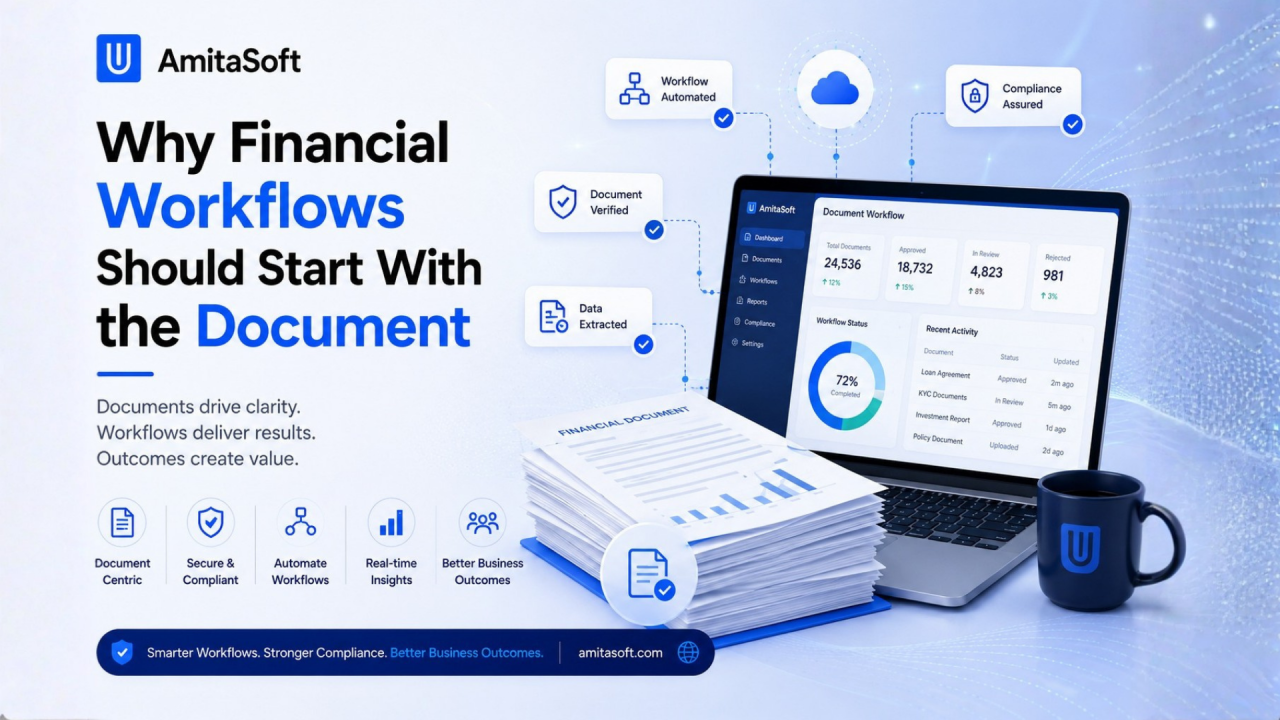
Every financial journey starts with a document.
Before a loan is approved, an invoice is paid, or a tax return is processed, someone uploads, scans, signs, or shares a document. Bank statements, W-2s, tax returns, invoices, purchase orders, mortgage applications these aren't just files sitting in a folder. They contain the information that drives every financial decision.
Yet, many organizations still treat documents as an afterthought.
Instead of building workflows around the document itself, they focus on moving data between CRMs, ERPs, spreadsheets, and other business applications. The result? Employees spend hours searching for files, re-entering information, correcting mistakes, and chasing approvals.
As financial operations become increasingly digital, this approach no longer works.
Today's leading organizations are rethinking their processes. They're starting with the document and letting technology do the heavy lifting from there.
The Real Bottleneck Isn't the Workflow It's the Document
Most finance teams have invested heavily in digital tools over the years. But despite having modern software, many processes still depend on manual work.
A customer uploads financial documents.
Someone downloads them.
Another employee manually enters the data into a business system.
Someone else checks for errors before forwarding everything for approval.
Finally, the documents are archived somewhere else.
On paper, the process looks digital. In reality, people are still doing repetitive tasks that software should handle automatically.
This creates familiar challenges:
- Hours lost to manual data entry
- Delays caused by document verification
- Duplicate work across multiple teams
- Version control issues
- Compliance headaches
- Increased risk of human error
Management expert Peter Drucker once said:
"Efficiency is doing things right; effectiveness is doing the right things."
For financial organizations, the "right thing" is making documents intelligent from the moment they enter the business, not after they've already slowed everything down.
A Document Is More Than Just a PDF
Think about a mortgage application.
To most systems, it's simply a PDF.
To a loan officer, it's proof of income, employment history, credit information, and supporting financial records.
That's a huge difference.
Modern AI can understand documents much like people do. Using technologies such as Intelligent Document Processing (IDP), Optical Character Recognition (OCR), and large language models (LLMs), software can identify document types, extract key information, validate data, and trigger the next step in the workflow automatically.
Instead of acting like digital filing cabinets, documents become active participants in business processes.
That means less manual work, fewer errors, and much faster decision-making.
Why a Document-First Approach Changes Everything
When organizations build workflows around documents instead of disconnected systems, every department benefits.
Faster Processing
Employees no longer need to copy information from one application to another.
AI can capture data directly from financial documents, dramatically reducing turnaround times for loans, invoices, tax filings, and customer onboarding.
Better Accuracy
Manual data entry is one of the biggest sources of operational mistakes.
Automated extraction and validation help ensure the right information reaches the right system the first time.
A Better Customer Experience
Nobody enjoys uploading the same document multiple times.
A document-first workflow allows information to flow across systems automatically, reducing duplicate requests and making the process much smoother for customers.
Stronger Compliance
Financial institutions operate in one of the most regulated industries in the world.
When documents are properly captured, classified, tracked, and stored from the beginning, audits become simpler, records are easier to locate, and compliance teams gain greater confidence in their processes.
The difficulty is rarely the audit itself. It is reconstructing months of activity from files that were never organized with review in mind. When capture, classification, and version history are built into the workflow rather than added afterwards, the evidence a compliance team needs already exists by the time anyone asks for it.
AI Is Making Documents Smarter
Artificial intelligence has changed the conversation around financial automation.
Just a few years ago, AI was mostly associated with chatbots and predictive analytics.
Today, it's helping finance teams process thousands of documents with remarkable speed and accuracy.
AI can automatically:
- Read bank statements
- Extract financial information
- Compare tax documents
- Detect missing pages
- Identify inconsistencies
- Route exceptions to the appropriate team
Instead of spending hours reviewing paperwork, employees can focus on customer relationships, strategic decisions, and higher-value work.
As AI expert Andrew Ng famously said:
"AI is the new electricity."
Much like electricity transformed every industry, AI is quietly transforming financial operations starting with documents.
How AmitaSoft Helps Organizations Build Smarter Financial Workflows
At AmitaSoft, we believe documents should do more than sit in storage waiting to be opened.
They should actively power business processes.
Our AI-driven document solutions help organizations capture, organize, process, and manage financial information from the moment a document enters the workflow.
Instead of juggling disconnected systems and manual processes, teams can create a single, intelligent document layer that supports faster operations, stronger compliance, and better collaboration.
Whether it's mortgage processing, financial services, tax documentation, or enterprise record management, a document-first strategy helps organizations move faster while reducing operational complexity.
It's not just about digitizing paperwork.
It's about making information instantly usable.
The Future of Finance Starts Earlier Than Most People Think
When businesses talk about digital transformation, they often focus on dashboards, analytics, or AI models.
But none of those technologies can deliver meaningful results if the underlying information is incomplete, inaccurate, or trapped inside documents that nobody can efficiently use.
That's why the future of Finance Technology, Finance AI, and intelligent automation begins much earlier.
It begins with the document.
When every document becomes structured, searchable, and connected to business workflows, organizations spend less time managing paperwork and more time making informed decisions.
That's a competitive advantage every finance team can appreciate.
Final Thoughts
Every invoice, loan application, tax return, compliance form, and customer record tells a story.
The question isn't whether those documents are important.
It's whether your systems are making the most of the information they already contain.
Organizations that put documents at the center of their financial workflows aren't simply improving efficiency, they're building a stronger foundation for automation, AI, compliance, and long-term growth.
At AmitaSoft, that's exactly the vision we're helping businesses achieve: transforming documents from static files into intelligent assets that power modern financial operations.