
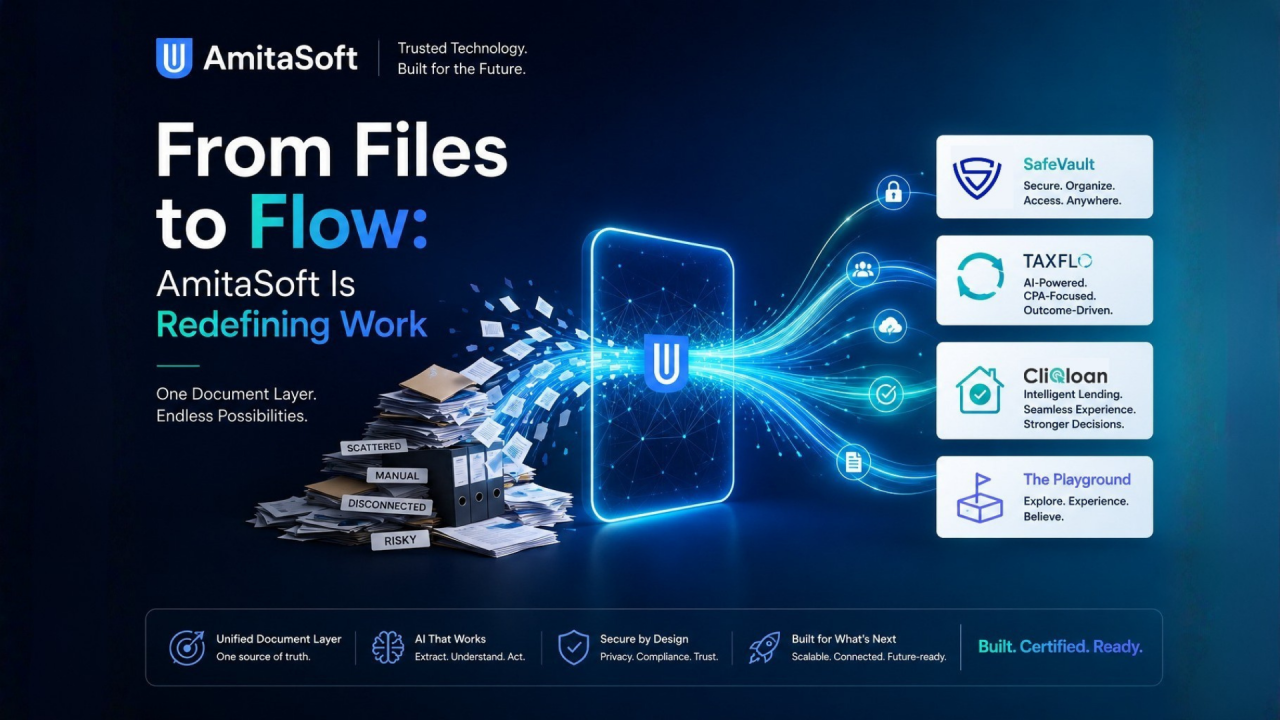
Every modern enterprise runs on documents.
From contracts and invoices to tax records, mortgage applications, compliance reports, and customer agreements, documents are at the center of every business process. Yet many organizations continue to rely on manual workflows that involve emailing files, searching through folders, renaming documents, and transferring information between disconnected systems.
While these tasks may seem minor, they create hidden costs that accumulate over time. Employees spend valuable hours on repetitive administrative work instead of focusing on strategic initiatives. Decisions are delayed, collaboration becomes difficult, and customers experience slower service.
The problem is no longer about where documents are stored, it's about how information moves across the organization.
As Bill Gates once said, "Automation applied to an efficient operation will magnify the efficiency. Automation applied to an inefficient operation will magnify the inefficiency." Businesses that continue relying on outdated document processes risk carrying those inefficiencies into the future.
The Real Cost of Manual Document Workflows
Manual document management affects nearly every department.
Finance teams spend time chasing approvals. HR collects employee records from multiple sources. Legal teams review different versions of contracts. Customer support searches across systems to locate client information.
Each delay may seem insignificant on its own, but together they create a ripple effect across the business.
Employees waste time looking for files instead of using them. Information gets duplicated, documents become outdated, and collaboration slows because teams are working from different versions of the same file.
The biggest cost isn't just productivity, it's lost business opportunities. When information doesn't flow efficiently, decision-making slows, projects are delayed, and customer satisfaction declines.
Why Traditional Document Storage Is No Longer Enough
Digital folders replaced filing cabinets, but they didn't solve the underlying problem.
Most organizations still manage documents the same way they did years ago, only now the folders are online instead of physical.
Modern businesses need more than storage. They need intelligent document workflows that connect people, processes, and systems.
This is where FinTech and modern Finance Technology are transforming enterprise operations.
Instead of treating documents as static files, intelligent platforms allow them to move automatically through business processes. Documents can trigger approvals, notify stakeholders, update systems, and support compliance without requiring constant manual intervention.
The result is faster operations and better collaboration across the organization.
How Finance AI Is Changing Enterprise Workflows
Artificial intelligence is redefining how businesses manage information.
With Finance AI, organizations can automatically classify documents, extract important information, identify missing data, and initiate workflows without manual input.
For example, a tax return uploaded by a customer can automatically move to the accounting team. A signed agreement can trigger approval workflows, while mortgage documents can be prepared for underwriting immediately after submission.
This reduces repetitive work while allowing employees to focus on higher-value activities.
As AI expert Andrew Ng famously said, "AI is the new electricity."
Just as electricity transformed industries over the last century, artificial intelligence is transforming document-driven businesses today.
Mortgage Lending Shows the Power of Intelligent Documents
Few industries depend on documentation as much as mortgage lending.
Every loan application requires income verification, tax returns, employment records, identification documents, bank statements, disclosures, and compliance paperwork.
Handling these documents manually often leads to delays, missing information, and slower approvals.
Modern Mortgage AI solves these challenges by automatically organizing borrower documents, identifying incomplete submissions, and supporting underwriting teams with structured information.
Borrowers benefit from faster approvals and better communication, while lenders reduce operational costs and improve efficiency.
The future of lending isn't just digital, it's document i ntelligence.
Cloud-Based Workflows Keep Everyone Connected
Today's workforce is more distributed than ever.
Employees work remotely, collaborate across offices, and serve customers from different locations. Traditional document storage systems struggle to support this flexibility.
Modern Finance Cloud Solutions provide a centralized environment where authorized users can securely access the latest information from anywhere.
Instead of maintaining multiple versions of the same document, organizations create a single source of truth that improves collaboration, reduces duplication, and supports business continuity.
Cloud technology also allows businesses to scale quickly without investing heavily in new infrastructure, making it an essential part of enterprise digital transformation.
Digital Lending Depends on Connected Information
The lending process relies entirely on accurate documentation.
When applications move through disconnected systems, delays become inevitable.
Modern Digital Lending Technology integrates document collection, verification, workflow automation, and customer communication into one connected platform.
Borrowers upload documents securely, track application progress in real time, and receive faster responses.
Meanwhile, lenders gain complete visibility into every application while reducing manual processing and administrative effort.
Connected document workflows create a better experience for both customers and employees.
Security Must Be Built Into Every Workflow
Financial and business documents contain some of an organization's most valuable information.
Protecting that information requires more than password-protected folders.
Modern Data Security Solutions combine encryption, role-based access controls, multi-factor authentication, audit trails, and continuous monitoring to protect documents throughout their lifecycle.
Strong security doesn't just reduce cyber risks, it also strengthens customer confidence.
When clients know their sensitive information is protected, trust naturally grows,creating stronger long-term business relationships.
Building Platforms Instead of Isolated Systems
Many organizations continue purchasing separate applications for different business functions.
One system manages customer relationships.
Another stores documents.
Another handles compliance.
Another supports reporting.
The result is fragmented operations where employees constantly move information between platforms.
Modern Digital Platform Development focuses on creating connected ecosystems instead of disconnected software.
Information flows automatically across departments, reducing manual work while improving visibility and collaboration.
Rather than managing documents in isolation, businesses create intelligent workflows that support every stage of their operations.
Technology Is Only Part of the Solution
Successful digital transformation is about more than implementing software.
Organizations also need the right strategy, integration, employee training, and continuous optimization.
Professional Technology Services help businesses implement solutions that align with operational goals while minimizing disruption.
Technology delivers the greatest value when it supports people and processes, not when it simply replaces existing tools.
As management expert Peter Drucker said, "There is nothing quite so useless as doing with great efficiency something that should not be done at all."
True transformation comes from improving workflows, not just automating outdated ones.
The Future Is Built on Connected Information
As organizations continue their digital transformation journey, they increasingly rely on experienced partners that understand both technology and business operations.
Working with a trusted Cloud Technology Company enables enterprises to build scalable, secure, and intelligent platforms that support long-term growth.
Cloud-native systems simplify compliance, strengthen disaster recovery, improve collaboration, and accelerate the adoption of emerging technologies such as AI.
Instead of reacting to change, organizations become prepared for it.
Conclusion
The hidden cost of manual document workflows extends far beyond administrative effort.
It appears in delayed decisions, duplicated work, compliance risks, frustrated employees, and slower customer experiences.
Organizations that embrace FinTech, Finance Technology, Finance AI, Mortgage AI, Finance Cloud Solutions, Digital Lending Technology, Data Security Solutions, Digital Platform Development, Expert Technology Services, and partnerships with a trusted Cloud Technology Company are building smarter and more resilient businesses.
The future of enterprise productivity isn't about creating more folders or storing more files.
It's about creating intelligent document workflows where information moves securely, automatically, and efficiently across every business process.
Businesses that make this shift today will be better equipped to innovate, adapt, and lead in an increasingly digital world.