
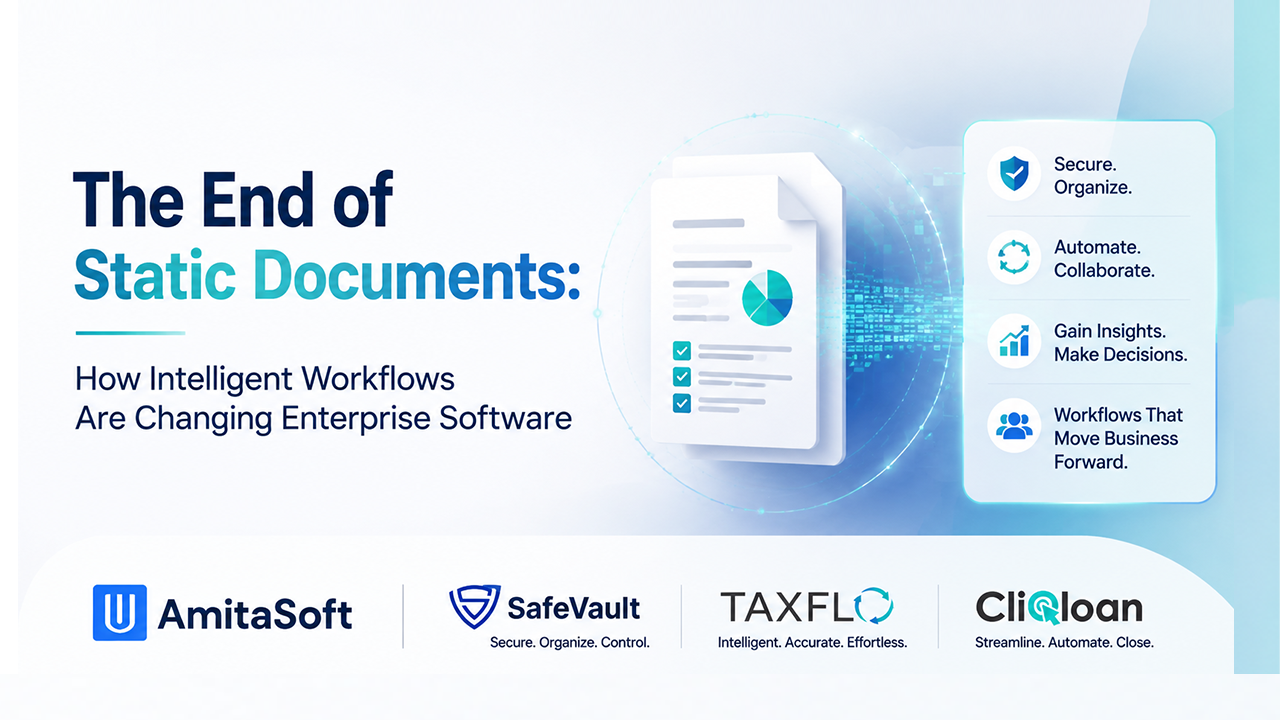
For decades, businesses have treated documents as something to store, search, and retrieve.
A contract gets uploaded. A tax document gets saved. A loan file gets archived.
But documents contain more than information; they contain decisions, actions, and opportunities.
The problem is that most businesses still rely on static document systems where information sits isolated inside folders, drives, and applications.
The next generation of enterprise software is changing this.
The future is not about storing more documents.
The future is about making documents understandable, actionable, and connected to workflows.
This is where intelligent document workflows come into play.
The Problem With Static Documents
Traditional document management systems solved one major problem:
“Where do we store files?”
But modern businesses face a bigger challenge:
“How do we turn information inside those files into action?”
A document sitting inside a folder does not:
- Identify important information
- Understand context
- Trigger workflows
- Recommend next steps
- Support business decisions
Companies today manage millions of documents across departments:
- Financial records
- Tax documents
- Mortgage files
- Contracts
- Compliance documents
- Customer information
Yet much of this information remains disconnected from daily operations.
From Document Storage to Document Intelligence
The evolution of enterprise software is moving through three stages:
1. File Storage
The first generation focused on storing information.
Examples:
- Shared drives
- Cloud storage platforms
- Digital folders
- The question was:
“Where is my document?”
2. Document Management
The next generation introduced organization.
Businesses could:
- Categorize files
- Control access
- Search documents
- Share information securely
- The question became:
“How can we manage our documents better?”
3. Intelligent Document Workflows
The future focuses on intelligence.
AI-powered document systems can:
- Understand document content
- Extract important information
- Classify documents automatically
- Connect information to workflows
- Support business decisions
- The question now becomes:
“What can this document help us accomplish?”
What Is Intelligent Document Processing?
Intelligent Document Processing (IDP) combines artificial intelligence, machine learning, and automation to transform documents into usable business intelligence.
Unlike traditional OCR systems that only read text, intelligent document processing understands:
- Document type
- Context
- Relationships between information
- Required actions
For example:
A mortgage document is not just a PDF.
It contains:
- Borrower information
- Financial details
- Verification requirements
- Approval steps
An intelligent workflow understands this and helps move the process forward.
Why Enterprises Need Intelligent Workflows
Modern businesses are struggling with disconnected processes.
Teams often work across:
- Spreadsheets
- Shared folders
- Multiple applications
This creates:
- ❌ Duplicate work
- ❌ Slow approvals
- ❌ Missing information
- ❌ Poor visibility
- ❌ Manual follow-ups
Intelligent workflows solve this by creating a connected information layer.
Documents Become the Starting Point of Business Automation
The biggest shift is this:
Documents are no longer the final destination.
They become the beginning of action.
A document can trigger:
Automated Decisions
AI can identify important information and route it to the right workflow.
Faster Collaboration
Teams can work from the same source of truth instead of searching across systems.
Better Customer Experiences
Customers and partners receive faster responses because information moves efficiently.
Reduced Manual Work
Employees spend less time organizing information and more time creating value.
How AmitaSoft Is Building the Future of Document Intelligence
At AmitaSoft, we believe documents should do more than sit inside systems.
They should power intelligent workflows.
Our ecosystem connects secure document management with industry-specific workflows.
SafeVault: The Secure Document Intelligence Layer
SafeVault provides a secure foundation where documents can be:
- Stored safely
- Organized intelligently
- Shared with control
- Accessed when needed
It transforms scattered files into a structured information layer.
TaxFlow: Turning Documents Into Tax Workflows
Tax professionals manage thousands of documents every tax season.
TaxFlow transforms document collection and preparation into a guided workflow.
With intelligent document processing, CPAs can:
- Organize client information
- Reduce document chasing
- Improve engagement visibility
- Create smoother tax preparation workflows
CliQloan: Transforming Mortgage Documents Into Lending Workflows
Mortgage teams deal with complex documentation every day.
CliQloan connects:
- Borrowers
- Loan officers
- Documents
- Lending workflows
- The result:
- Better collaboration
- Faster processing
- Clearer borrower experiences
The Future of Enterprise Software Is Workflow Intelligence
The next generation of software will not be defined by how many files it can store.
It will be defined by how intelligently it can use information.
Companies will move from:
Files → Information → Intelligence → Action
Static documents are becoming intelligent business assets.
Final Thoughts
Every business has documents.
The question is:
Are your documents just stored, or are they helping your business move forward?
The future belongs to organizations that can transform information into action.
Intelligent workflows are not replacing documents.
They are unlocking their potential.
The era of static documents is ending. The era of intelligent workflows has begun.