
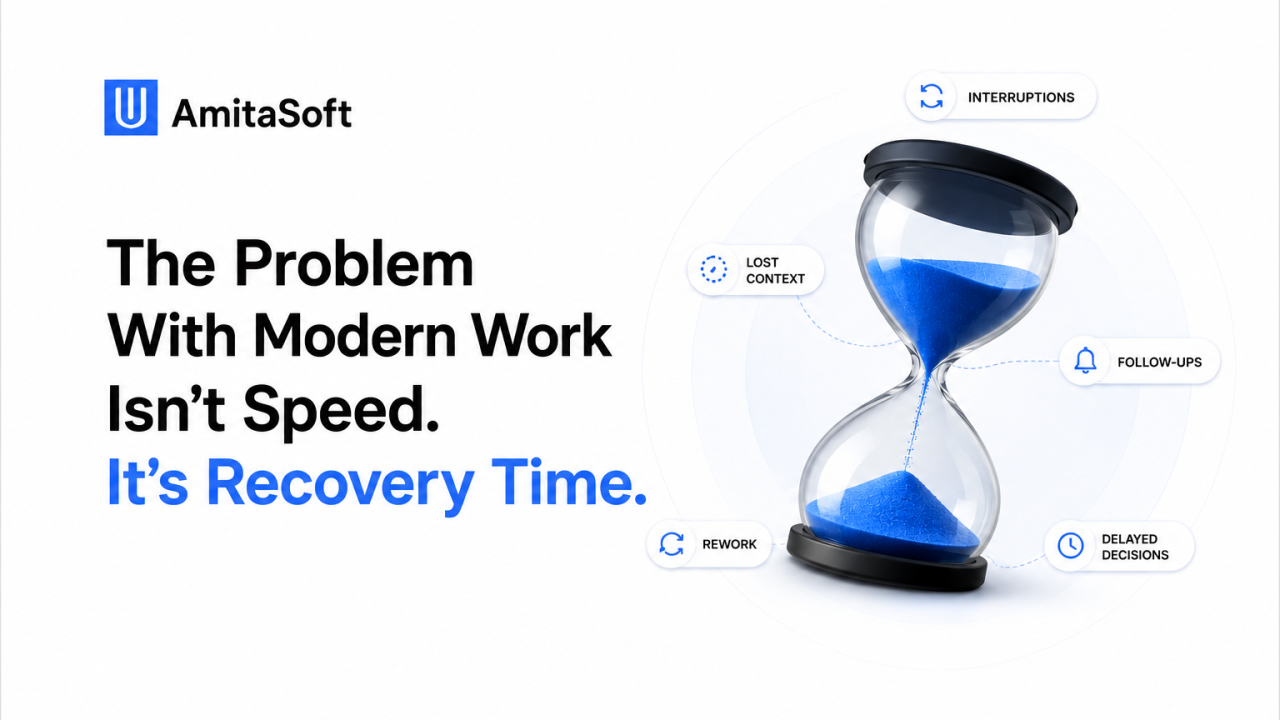
Modern organizations are obsessed with speed.
Faster execution. Faster approvals. Faster delivery. Faster communication.
Every tool promises acceleration.
But speed isn’t the real problem anymore.
Because most teams today are already moving fast.
The real problem is something else:
Recovery Time.
What Happens When Work Breaks
A document goes missing.
An approval gets delayed.
Someone misses context in a thread.
A workflow pauses because one dependency was overlooked.
At first, these feel like small issues.
But what actually consumes time isn’t the mistake itself.
It’s everything that happens after.
Finding the missing information
Rebuilding context
Following up with stakeholders
Rechecking decisions
Recovering momentum
That’s where modern teams lose time.
Not in execution.
In recovery.
The Hidden Cost Nobody Measures
Most organizations measure:
- productivity
- throughput
- delivery speed
- output
- Very few measure:
- interruption recovery
- workflow friction
- coordination lag
- context rebuilding
But these invisible delays quietly compound across the organization.
A five-minute interruption rarely costs five minutes.
It often creates:
- broken focus
- delayed decisions
- duplicated effort
- communication overhead
And over time, the organization starts slowing down — even while everyone appears busy.
Why Faster Tools Don’t Solve This
Adding more tools doesn’t automatically improve flow.
In many cases, it creates more fragmentation:
- more notifications
- more dashboards
- more disconnected updates
- more places where context gets lost
The issue is no longer access to information.
The issue is maintaining continuity around work.
Because when continuity breaks, recovery begins.
And recovery is expensive.
Modern Workflows Need Resilience, Not Just Speed
The most effective systems today are not simply faster.
They are more resilient.
They reduce the amount of recovery required by:
- maintaining operational context
- creating visibility across workflows
- reducing dependency confusion
- structuring information clearly
- keeping work moving without constant manual intervention
The goal is not just moving faster.
The goal is reducing the operational cost of disruption.
Why This Matters More Than Ever
As organizations scale:
- teams become more distributed
- workflows become more interconnected
- dependencies increase
- decision cycles grow more complex
And small operational gaps begin multiplying faster than teams can manage manually.
That’s when recovery time becomes a business problem — not just an operational one.
The Shift Organizations Need To Make
For years, companies optimized for speed.
The next generation of organizations will optimize for:
- continuity
- operational clarity
- resilience
- recoverability
Because sustainable performance is not about avoiding disruption completely.
It’s about minimizing the cost of recovering from it.
Final Thought
Most organizations think they have a speed problem.
In reality, they have a recovery problem.
And the organizations that reduce recovery friction first will move faster than everyone else.
Not because they work harder.
But because they lose less momentum.