
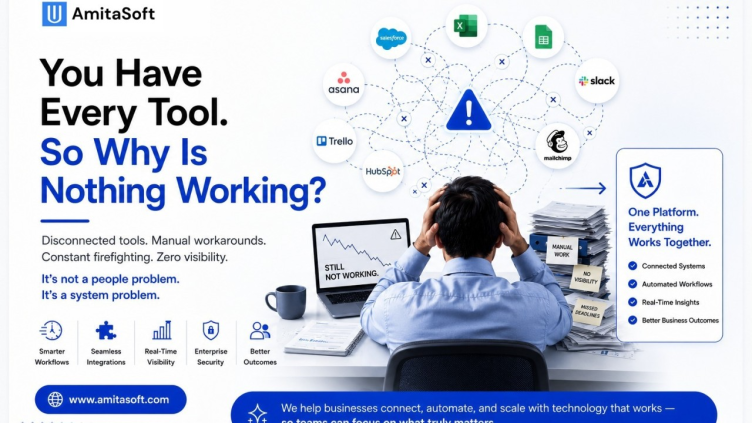
More software, more subscriptions, more platforms, and somehow, less gets done than ever before. Welcome to the modern business paradox.
Honestly, this is something we see happening almost every day now. And if you’ve worked in this space, you’ll probably relate to this instantly. Picture this. It is 9 AM on a Monday morning. Your loan officer opens their laptop and stares at a screen full of browser tabs. There is the CRM. The document portal. The compliance checker. The e-signature platform. The communication tool. The analytics dashboard. The task manager. The LOS system. And somewhere buried in there, three unread email threads about a file that should have closed last Friday.
They have every tool their industry told them they needed. They paid for every subscription their vendor promised would transform their workflow. And yet somehow, at 9 AM on a Monday morning, they have never felt more behind.
This is not a unique story. This is the defining operational crisis of modern business, and it is hitting FinTech companies, mortgage operations, and technology firms harder than almost any other industry on the planet.
The Promise That Broke
At one point, this actually felt like the smartest way to scale. More tools meant more efficiency, or at least that’s what we all believed. Cast your mind back to the early days of the SaaS revolution. The promise was intoxicating and simple: for every business problem, there is a software solution. Need better document management? There is a tool for that. Need faster compliance? There is a tool for that. Need smarter communication, sharper analytics, faster approvals, or cleaner data? There is a tool, a tool, a tool, and another tool for all of that.
And so businesses bought. And bought. And bought some more. The average mid-sized financial services company today runs between 40 and 60 separate software applications across its operations. Mortgage lending teams juggle loan origination systems, point-of-sale platforms, document verification tools, CRM systems, e-signature solutions, and compliance trackers, often from six different vendors with six different interfaces, six different login credentials, and six completely different philosophies about how data should flow.
The promise was efficiency. What the finance technology industry delivered instead was fragmentation. And fragmentation, it turns out, is the single most effective productivity killer ever invented—one that compounds silently across every team, every workflow, and every quarter until the damage becomes impossible to ignore.
The Real Cost of Too Many Tools
Here is what the SaaS vendors never put in their pitch decks. Every tool your team uses does not just cost a subscription fee. It costs something far more valuable and far harder to recover: attention. Cognitive scientists have known for decades that context switching, the act of moving between different tasks, interfaces, and mental frameworks, carries a measurable productivity penalty. Research consistently shows that it takes an average of 23 minutes for a knowledge worker to fully regain their focus after switching tasks. In an environment where a mortgage professional might switch between eight different platforms in the course of processing a single loan file, that penalty is not occasional. It is constant. It is structural. It is baked into every single working hour.
Now add the data problem. When your business operates across a fragmented stack of disconnected tools, your data lives in silos. The document portal does not talk to the CRM. The compliance checker does not sync with the LOS. The analytics dashboard is pulling numbers from last Tuesday because the integration broke and nobody noticed. Decisions get made on incomplete information. Errors get introduced at every handoff point. And without proper data security solutions governing how information moves between platforms, sensitive borrower data is exposed at every one of those handoff points, creating regulatory risk that most operations do not even know they are carrying.
In the mortgage industry specifically, this fragmentation has a direct and measurable impact on closing timelines, borrower satisfaction, and regulatory standing. Every disconnected system is a gap where a document can get lost, a deadline can get missed, and a borrower can lose confidence and walk away from the table entirely.
Why Smart Teams Keep Buying More Tools Anyway
If tool fragmentation is so clearly damaging, why do intelligent, experienced business leaders keep adding to their stacks instead of simplifying them? The answer is surprisingly human. When a specific problem surfaces, a compliance gap, a communication breakdown, or a document tracking failure, the instinct is to find the best available solution to that specific problem. And in a marketplace overflowing with specialized finance cloud solutions and brilliantly marketed SaaS products, there is almost always a tool that appears to solve exactly that problem perfectly.
The issue is that solving individual problems in isolation creates systemic fragmentation at the organizational level. You fix the document tracking problem with Tool A. You fix the communication problem with Tool B. You fix the analytics problem with Tool C. And suddenly you have three new tools that each do their individual job reasonably well but create three new integration headaches, three new training burdens, and three new sources of data inconsistency across your operation.
This is where things start to get really interesting because the problem isn’t a lack of awareness; it's something deeper. This is what digital platform development strategists are increasingly calling the integration tax. Every tool you add to your stack does not just add its own subscription cost. It adds integration complexity, maintenance overhead, and cognitive load that compounds across your entire team every single day. And for any cloud technology company or financial services operation trying to scale, that compounding cost eventually becomes the single biggest obstacle to growth, not the market, not the competition, and not the talent pool. If tool fragmentation is so clearly damaging, why do intelligent, experienced business leaders keep adding to their stacks instead of simplifying them?
And when you look at it closely, you realize it’s not really a bad decision in isolation. It just becomes a problem when these decisions start stacking up. The answer is surprisingly human. When a specific problem surfaces, a compliance gap, a communication breakdown, or a document tracking failure, the instinct is to find the best available solution to that specific problem. And in a marketplace overflowing with specialized finance cloud solutions and brilliantly marketed SaaS products, there is almost always a tool that appears to solve exactly that problem perfectly.
And this is exactly where things start to spiral without most teams even noticing. What feels like progress in the short term quietly becomes a bottleneck over time. The issue is that solving individual problems in isolation creates systemic fragmentation at the organizational level. You fix the document tracking problem with Tool A. You fix the communication problem with Tool B. You fix the analytics problem with Tool C. And suddenly you have three new tools that each do their individual job reasonably well but create three new integration headaches, three new training burdens, and three new sources of data inconsistency across your operation.
This is what digital platform development strategists are increasingly calling the integration tax. Every tool you add to your stack does not just add its own subscription cost. It adds integration complexity, maintenance overhead, and cognitive load that compounds across your entire team every single day. And for any cloud technology company or financial services operation trying to scale, that compounding cost eventually becomes the single biggest obstacle to growth, not the market, not the competition, and not the talent pool.
The Consolidation Shift Nobody Is Talking About Loudly Enough
And the smartest teams have already started to figure this out. They’re not asking, "What else can we add?” They're asking, "What can we remove?” Something interesting is happening among the highest-performing FinTech and mortgage operations right now. They are not adding tools. They are removing them.
The most operationally efficient lending teams, the fastest-growing finance technology companies, and the most compliance-resilient mortgage operations in the market share one counterintuitive characteristic: they run leaner technology stacks than their peers. Not because they cannot afford more tools. But because they have done the math on what fragmentation actually costs and decided that consolidation is the most powerful operational decision available to them.
And this is where the narrative really starts to shift. What once felt like a trade-off is now becoming an obvious advantage. This shift is being accelerated by the maturation of finance AI and mortgage AI capabilities. A few years ago, consolidation meant compromise, choosing a platform that did everything adequately but nothing exceptionally. Today, AI-powered unified platforms are genuinely capable of matching or exceeding the performance of specialized point solutions across document management, compliance tracking, borrower communication, and workflow automation simultaneously.
The result is that the argument for maintaining a fragmented stack of specialized tools is becoming harder to make with every passing quarter. When a single digital lending technology platform powered by AI can validate documents, track compliance, manage borrower communication, and generate real-time analytics all within one unified data environment, the integration tax of running six separate tools to accomplish the same outcome simply cannot be justified.
What This Means for FinTech and Mortgage Leaders Right Now
At some point, every team starts to feel this, even if they can’t immediately explain it. And that’s usually the signal that something deeper needs to change. If your team is feeling the friction of too many tools, the answer is not another tool to manage the other tools. The answer is an honest audit of what your stack is actually delivering versus what it is actually costing in subscription fees, in integration headaches, in training time, in data quality, and in the invisible productivity tax your team pays every single day just to move information from one platform to another.
Any serious technology services provider will tell you the same thing: the ROI conversation in enterprise software has fundamentally changed. It is no longer enough to evaluate each tool in isolation based on what it does. The evaluation has to include what each additional tool costs the organization in integration complexity, security exposure, and cognitive overhead across the entire team.
Ask your loan officers how many systems they touch to process a single file. Ask your compliance team how many platforms they need to access to build a complete audit trail. Ask your operations manager how many integration failures they dealt with last quarter. The answers will tell you everything you need to know about where your efficiency is actually going and how much of it your current stack is silently consuming.
The Bottom Line
The modern business paradox is real. More tools genuinely can produce less output when those tools are fragmented, disconnected, and optimized for their individual function rather than for the coherence of your overall operation.
The FinTech and mortgage leaders who will define the next decade of their industries are not the ones who find the best tool for every problem. They are the ones who build operations on unified finance cloud solutions and digital platform development infrastructure coherent enough that the problems requiring new tools stop appearing in the first place.
Simplicity, it turns out, is the most sophisticated strategy available to any cloud technology company or lending operation competing in today's market. And in an industry drowning in software solutions, the teams brave enough to consolidate around intelligent, AI-powered digital lending technology platforms will be the ones with the clearest pipelines, the happiest borrowers, and the strongest margins when the dust settles.
The question is not how many tools your business has. The question is how many of them are genuinely working together and how many are just adding noise.