
Audit Readiness Must Be Enforced — Not Reconstructed
In regulated, document-driven industries, audit readiness is often treated as something to deal with later. As long as the information exists somewhere—documents are stored, workflows are completed, statuses are updated—there’s a belief that everything can be reconstructed when needed. On paper, that sounds reasonable. In reality, it’s one of the most dangerous assumptions an organization can make.
Because audit trails don’t fail due to missing data. They fail because the data doesn’t connect. At AmitaSoft, we believe audit readiness is not a future task. It’s a continuous system capability. It must exist at all times—built into how decisions are made, recorded, and preserved.
The Illusion of Audit Readiness
Most modern systems create a sense of control. Documents are stored, actions are logged, workflows are visible, and reports can be generated instantly. From the outside, everything appears organized and audit-ready.
But audit readiness is not about having data. Modern Finance Technology platforms are expected not just to track activity, but to explain it with complete clarity and structure.
It’s about having reliable, connected evidence. Auditors don’t want to guess. They want certainty. They want to know who did what, when it happened, under what authority, and based on which document. More importantly, they want to understand how each step connects to the next. If your system cannot answer those questions directly—without digging through emails, stitching together logs, or interpreting fragmented information—it isn’t audit-ready.
It’s audit-dependent.
Why Fragmented Evidence Fails Under Scrutiny
In many organizations, the information needed for audits does exist—but it’s scattered. A document lives in one system. An approval exists in an email thread. A status update sits in a workflow tool. A key decision was made in a call. Each piece, on its own, appears valid.
But audits don’t evaluate pieces. They evaluate continuity.
When evidence is fragmented, teams are forced to reconstruct the decision path manually. They switch between systems, search through conversations, and attempt to rebuild timelines. And that’s where things start to break down. Because reconstruction introduces uncertainty. And in regulated environments, uncertainty is a risk.
The Problem With Reconstructing Decisions Later
Reconstruction often feels like a solution. In reality, it’s a workaround. Teams gather logs, retrieve documents, review communication threads, and try to recreate what happened. But what they’re building isn’t proof—it’s interpretation.
By the time an audit occurs, context may already be lost. People may have changed roles or left the organization. Informal decisions may never have been recorded. Document versions may have changed. What remains is an incomplete story—one built on assumptions. And assumptions don’t hold up under scrutiny. Audit-ready systems don’t rely on reconstruction. They capture the complete story at the moment decisions occur.
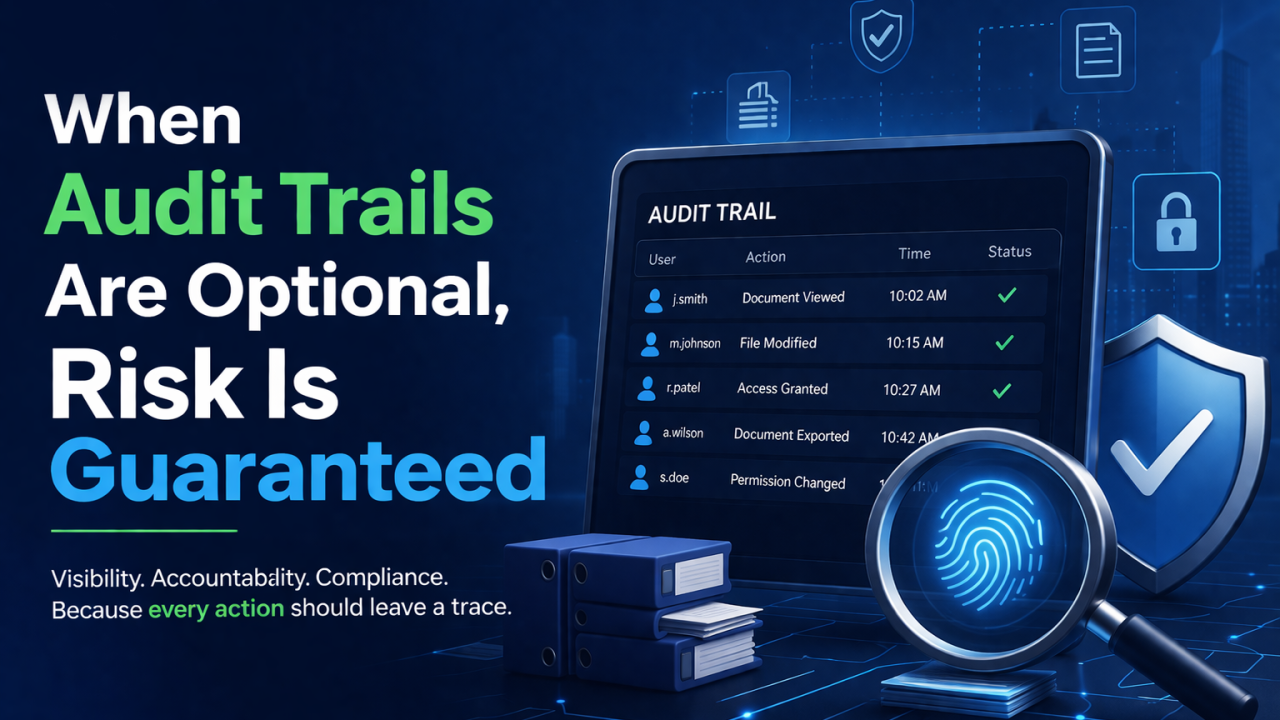
When Audit Trails Are Optional, Gaps Are Inevitable
One of the most common design flaws in enterprise systems is treating audit trails as optional. Some actions are recorded. Others are not. Some approvals are documented. Others are assumed. Some access is tracked. Others are ignored. This creates selective visibility. And selective visibility creates gaps.
Over time, those gaps accumulate into fragmented audit trails—missing key decisions, lacking context, and disconnected from the evidence that supports them. This is not a technology limitation. It’s a design decision. If a system allows actions to happen without automatically generating traceable records, it is allowing accountability to slip. And in regulated industries, that’s where risk lives.
Event-Level Traceability: Capturing Truth in Real Time
True audit readiness begins with one principle: capture everything as it happens. Every approval, every document interaction, every workflow transition must be recorded as a structured event—instantly and automatically. Not after the fact. Not inferred later. Captured in real time.
Event-level traceability ensures that every decision is tied to a user, a defined authority, a precise timestamp, a governing rule, and a specific document version. This creates a continuous, verifiable chain of evidence—one that never needs to be reconstructed. In industries like mortgage and lending, where every action carries compliance implications, this level of traceability is not optional.
It is essential.
Approval and Access History: Turning Activity Into Evidence
Capturing events is only part of the solution. The real value comes from context. An approval without authority is just a record. A document access without purpose is just activity. A workflow transition without reasoning is just movement. This is where approval and access history becomes critical.
SafeVault ensures that every interaction is not just recorded, but governed and contextualized. Access is controlled, approvals are tied to document states, and every action is linked to its purpose and authority. This means the system doesn’t just show what happened. It shows why it was allowed to happen. And that’s what transforms activity into defensible evidence.
How CliQloan and SafeVault Work Together
Audit readiness is not achieved through a single system. It requires alignment between workflows and documents. CliQloan governs how decisions are made. Workflows progress only when defined conditions are met. Approvals are enforced within structured roles. Actions cannot occur outside the system. SafeVault governs the evidence behind those decisions. Document versions are preserved, access is controlled, and approval context is tied directly to document lifecycle states.
Together, they eliminate fragmentation. Decisions are captured. Evidence is preserved. Context is maintained. The result is not just visibility—but continuity. And continuity is what audits require.
From Audit Preparation to Audit Confidence
Organizations with fragmented systems approach audits with effort. They prepare, verify, and reconstruct. Organizations with structured systems approach audits with confidence. They don’t prepare. They present.
Because everything is already there—connected, traceable, and defensible. That shift—from effort to confidence—is what defines modern, resilient systems.
Why the Future Belongs to Systems That Preserve Truth
As regulatory expectations increase and automation accelerates, the tolerance for fragmented evidence is disappearing. It’s no longer enough to store data. Systems must preserve truth. At AmitaSoft, we design platforms where audit trails are not optional features. They are automatic outcomes of every action, every approval, and every document interaction.
Because in regulated industries, risk does not come from missing data. It comes from missing connections. And when those connections are not preserved, organizations are left with activity—but no defensible evidence. Audit readiness is not something you build later. It is something your system must guarantee from the start.
Because when audit trails are optional, risk is inevitable.
At AmitaSoft, we are building systems that bring structure, clarity, and control to complex workflows.Our products focus on solving real operational gaps across industries:
- • SafeVault — Secure document management, governance, and compliance 🌐 www.safevaultusa.com
- • CliQloan — AI-driven loan processing and automation platform 🌐 www.cliqloan.com
If you're exploring how to improve workflows, reduce risk, or build more reliable systems, feel free to explore or reach out.