
Every February a managing partner does the same arithmetic. Six preparers, four hundred returns, ten weeks. It works on paper. It does not work in the office, and by the second week of March the conversation has turned to hiring someone before next season.
The arithmetic is usually right. The assumption under it is wrong. It treats CPA firm capacity as the number of returns your staff can prepare, when the real limit in most firms is how many returns can be worked on at all on a given morning.
Capacity is throughput, not headcount
A preparer who can finish three returns a day does not finish three returns a day. They finish the returns that have everything needed to be finished. The rest sit at eighty percent, waiting on a K-1 or a clarification, holding a slot and producing nothing.
Add a seventh preparer to a firm where half the open engagements are waiting on documents and you have bought yourself a seventh person waiting on documents.
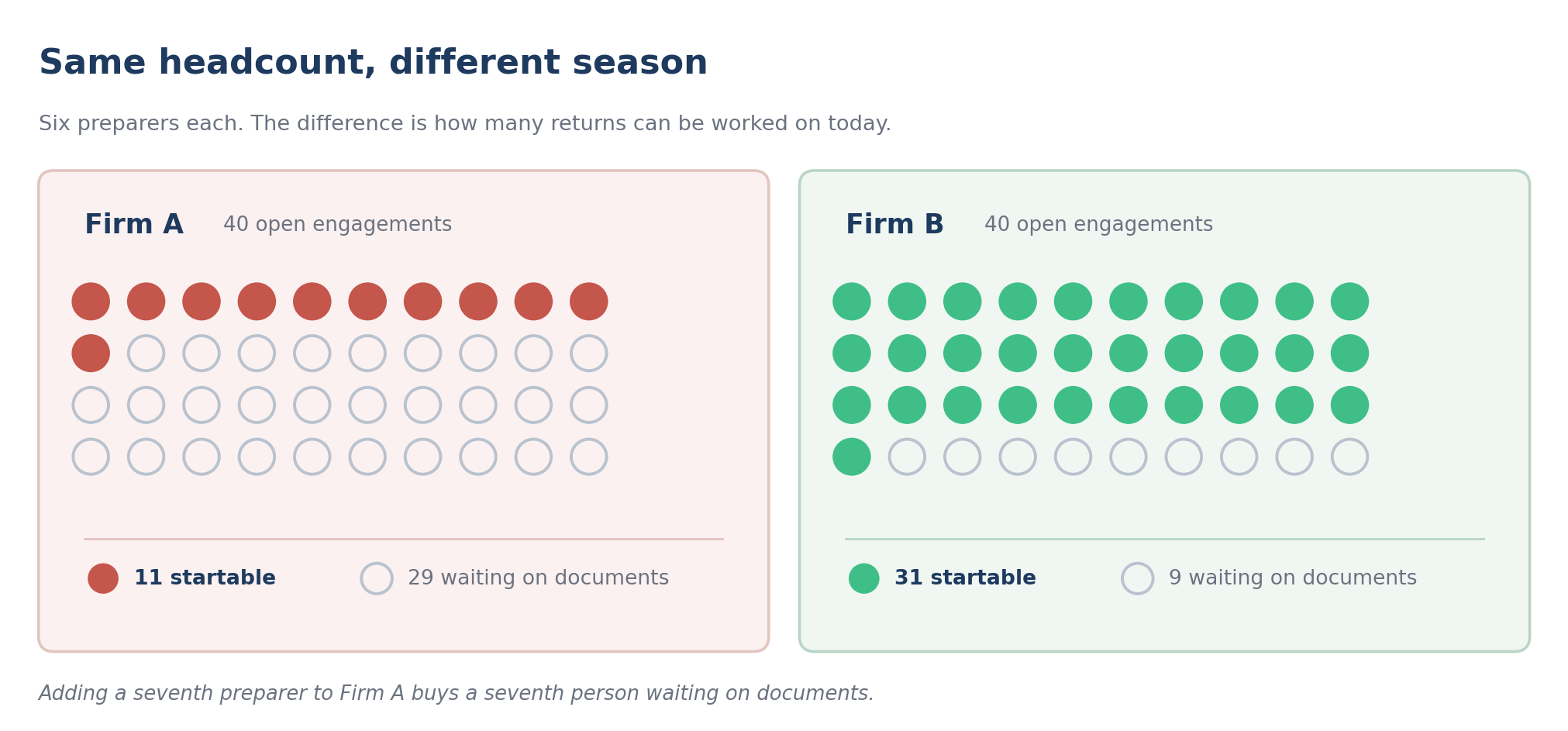
Same headcount, different season
Six preparers each. The difference is how many returns can be worked on today.
Firm A
- 11 startable
- 29 waiting on documents
Firm B
- 31 startable
- 9 waiting on documents
Adding a seventh preparer to Firm A buys a seventh person waiting on documents.
This is why two firms with identical headcount and identical client lists finish weeks apart. The difference is almost never talent.
The number that predicts April
Most firms track two numbers through the season: returns filed and returns remaining. Both are lagging. By the time returns remaining looks alarming it is the third week of March and none of your options are good.
Track a third number, daily, from the first week of January:
Startable returns. Of everything open, how many could a preparer pick up right now and carry to review without stopping to ask the client for anything.
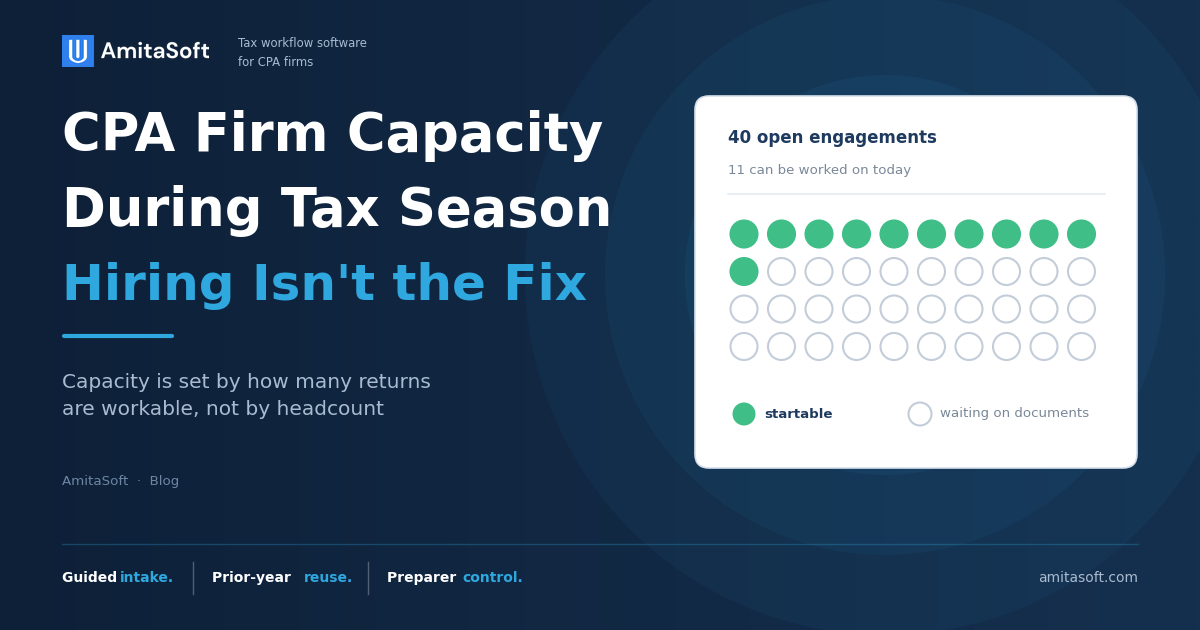
If you have forty engagements open and eleven are startable, you do not have a staffing problem. You have eleven returns of capacity, no matter how many people are sitting at desks. That number tells you in January what your April looks like, which is the only point in the season when you can still do something about it.
Where capacity leaks
The eighty percent return
A return that is almost done is worse than one that has not been started. It has consumed preparer time, it occupies a slot in someone's queue, and it will need re-reading when the missing document turns up, because nobody remembers the details three weeks later.
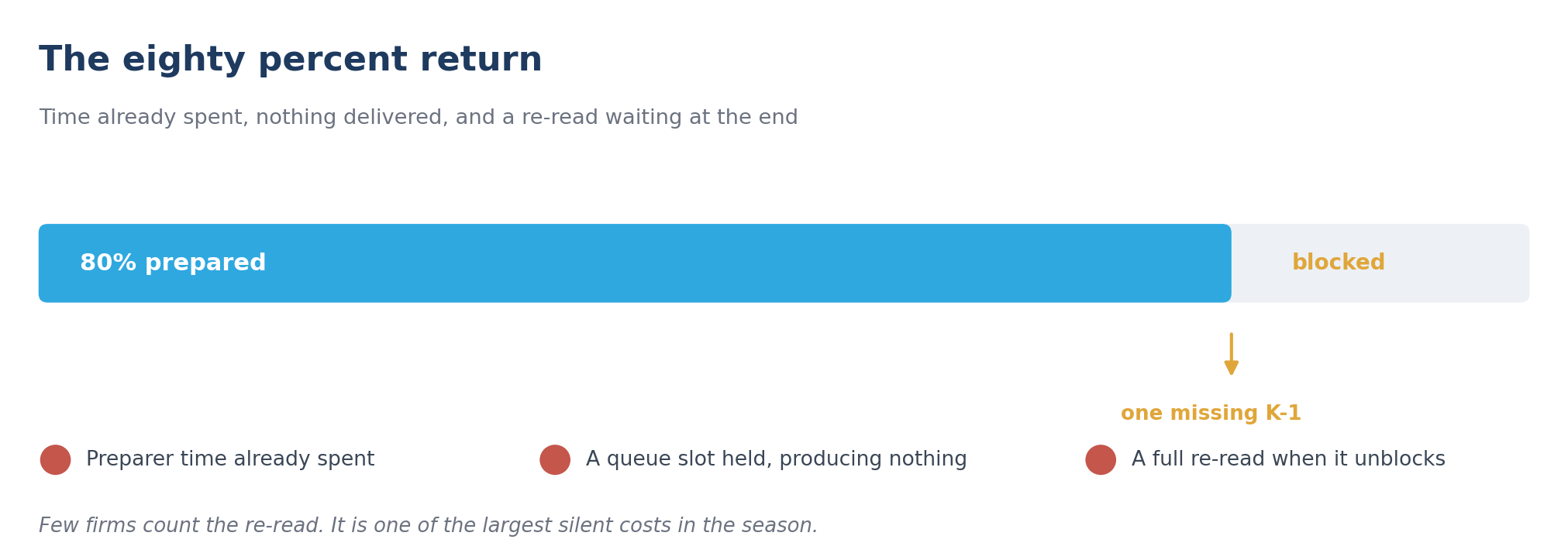
The eighty percent return
Time already spent, nothing delivered, and a re-read waiting at the end.
-
80% prepared
Preparer time already spent
-
Blocked — one missing K-1
A queue slot held, producing nothing
-
When it unblocks
A full re-read when it unblocks
Few firms count the re-read. It is one of the largest silent costs in the season.
Few firms count that re-reading. It is one of the largest silent costs in the season.
Switching between half-finished files
A preparer working through six partially complete returns pays the cost of picking each one up. Where was I. What is missing. What did the client say. Each restart is a few minutes of reconstruction, several times a day, for ten weeks.
The fix is not discipline. It is having fewer half-finished files.
One reviewer, six preparers
In most small firms review sits with one or two partners who are also handling their own clients, planning work, and answering the phone. Preparation capacity can be added. Review capacity often cannot, because it is attached to a specific person.
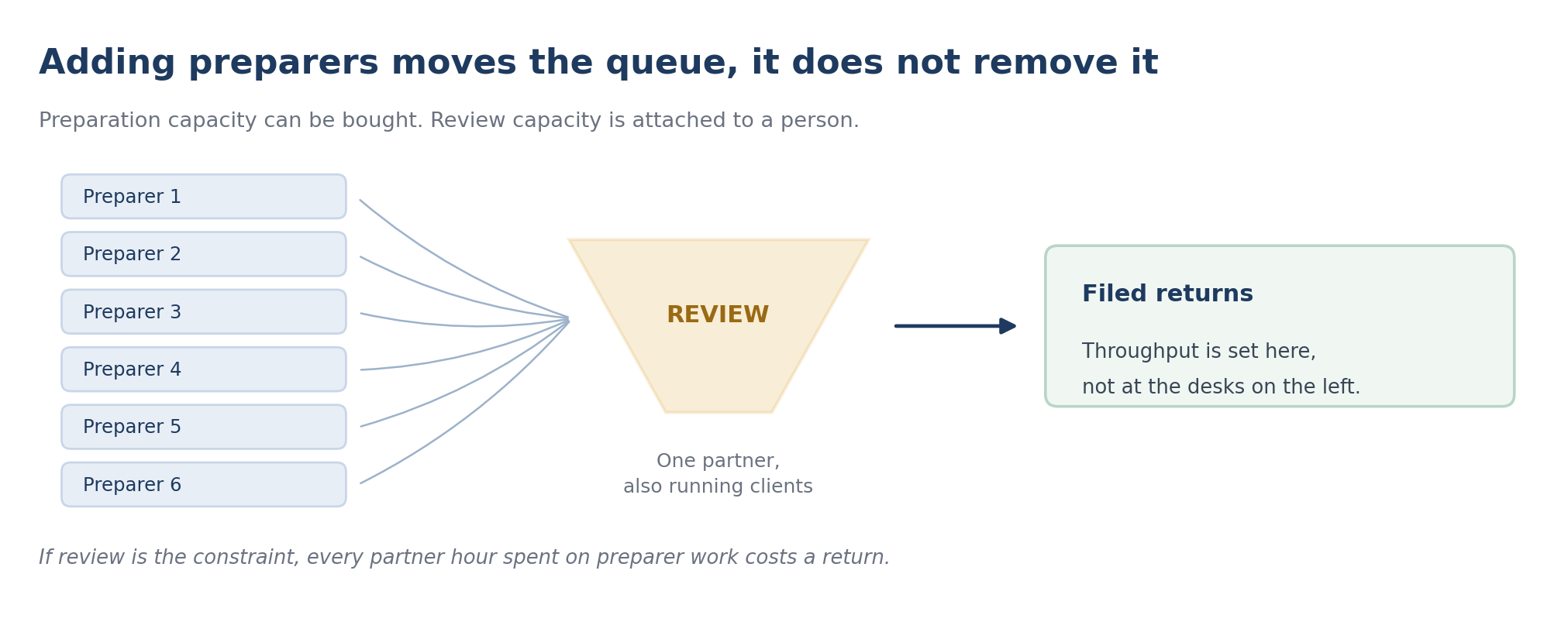
Adding preparers moves the queue, it does not remove it
Preparation capacity can be bought. Review capacity is attached to a person.
-
Preparer 1–6
Preparation capacity can be bought.
-
Review
One partner, also running clients
-
Filed returns
Throughput is set here, not at the desks on the left.
If review is the constraint, every partner hour spent on preparer work costs a return.
When preparation speeds up and review does not, the queue moves from one bottleneck to a worse one.
Sequence intake so returns arrive complete
The single biggest lever on startable returns sits before the season starts.
A return becomes startable when the documents are in. That depends on how the request was written, when it went out, and whether the client had one obvious place to send things. Firms that fix their document request list in December start January with a different number.
Two things matter more than the rest:
- Send the request before the client's documents arrive. A list that lands in mid-December is waiting for them as the mail comes in. A list that lands in February is competing with everything else on their desk.
- Build it from the prior-year return, not a template. A generic list produces generic responses and a second round of questions.
More on this in our piece on reducing tax season follow-ups.
Cap how many returns are open at once
This is the change firms resist most and benefit from fastest.
Instead of opening every engagement in January, open them in waves sized to your startable capacity. Returns that are not yet startable stay in a holding queue where the follow-up owner works on them, and they enter a preparer's queue only when they are complete.
Two objections come up. Both deserve a straight answer.
Clients will feel deprioritized. They will not, because nothing changes from their side. The request still went out in December. What changes is that a preparer does not open the file until it can be finished.
It will slow us down in January. January feels slower. March is not, because you are not carrying thirty half-finished returns into it.
Protect review capacity
If review is your constraint, then every hour a partner spends on something a preparer could do costs you a return.
Three things worth defending before the season:
- A written review standard, so preparers stop guessing what a partner will send back
- A logged list of what gets returned most, which is training material for next season and usually five recurring items
- Blocked review time, on the calendar, that does not get given away to client calls in the second week of March
The last one only holds if the managing partner decides it in November. Nobody defends their calendar in March.
What to measure this season
Four numbers, tracked weekly, and none of them require new software:
- Startable returns, as a share of open engagements
- Days from initial request to complete file, by client
- Returns re-opened after review, and what triggered it
- Follow-ups sent, by document type
By April you will know whether your constraint is intake, preparation, or review. Most firms discover it is intake, which is the cheapest of the three to fix and the one they had no plans to spend money on.
Frequently asked questions
How many tax returns can one CPA prepare in a season?
The number varies too much to be useful as a benchmark, because it depends on return complexity, software, staffing mix, and how complete the files are when they reach the preparer. The more useful question is how many returns a preparer can finish without stopping, which is governed by document intake rather than preparation speed. A firm whose files arrive complete gets more out of the same people than a firm whose files arrive in pieces.
Should a CPA firm hire seasonal staff for tax season?
Sometimes, but check the constraint first. If most open engagements are waiting on client documents, extra preparers will wait alongside the existing ones. If files arrive complete and preparers are the queue, seasonal help works. Hiring solves a preparation bottleneck and does nothing for an intake or review bottleneck.
What is work in progress in a CPA firm?
Work in progress is every engagement that has been started and not delivered, including returns sitting at eighty percent waiting on a document. It matters because each open file consumes attention whether or not it is moving. Firms that cap how many engagements are open at once usually finish the season sooner than firms that open everything in January.
How do you measure tax season capacity?
Count startable returns rather than total returns. Of everything open, how many could a preparer complete today without contacting the client. Tracked from early January, that share tells you whether your season is going to work, while there is still time to change the answer.
Where AmitaSoft fits
Everything above can be run on a spreadsheet by a firm that is disciplined about it. What breaks is not the method. It is knowing, at nine in the morning, which of your open engagements are startable, without opening each one.
TaxFlo is our tax workflow software for CPA firms. It runs the engagement rather than the folder. Each engagement shows what has arrived and what is still outstanding, so the question of which returns are ready to work is answered at a glance. Clients move through a guided intake that adapts to their situation instead of a standard checklist, and documents already held from last year get offered for reuse rather than requested again, which is what moves a file to startable sooner.
The preparer stays in control. Every suggestion goes to a preparer to approve, change, or override, and overrides get logged, so the way your firm works shapes what the system suggests next season. TaxFlo does not prepare or file the return. Your firm does that the way it does today.
Firms access TaxFlo through the SafeVault provider portal. You apply, get reviewed, and then manage engagements from your own dashboard.
If you want to know what your startable number looks like before January, schedule a demo and we can walk through where your files are stalling.