
By late February a firm is fielding a steady stream of the same three questions. Did you get my documents. When will my return be ready. Do I need to do anything else. Each takes a few minutes to answer and interrupts whoever answers it.
Firms treat that as the cost of having clients. It is closer to a scheduling problem. Almost every one of those questions is a message the firm meant to send and did not, arriving in the opposite direction and at a worse time.
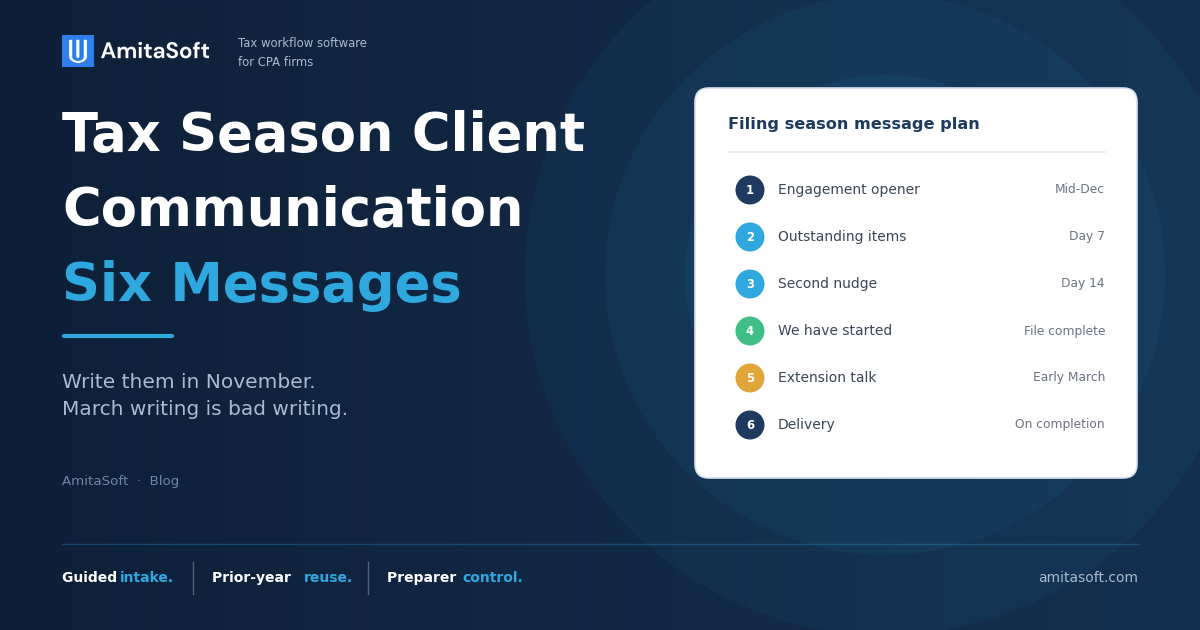
Tax season client communication works when the client hears from you before they need to ask. That is a matter of writing six messages in November, not of being more responsive in March.
Inbound questions are a symptom, not a workload
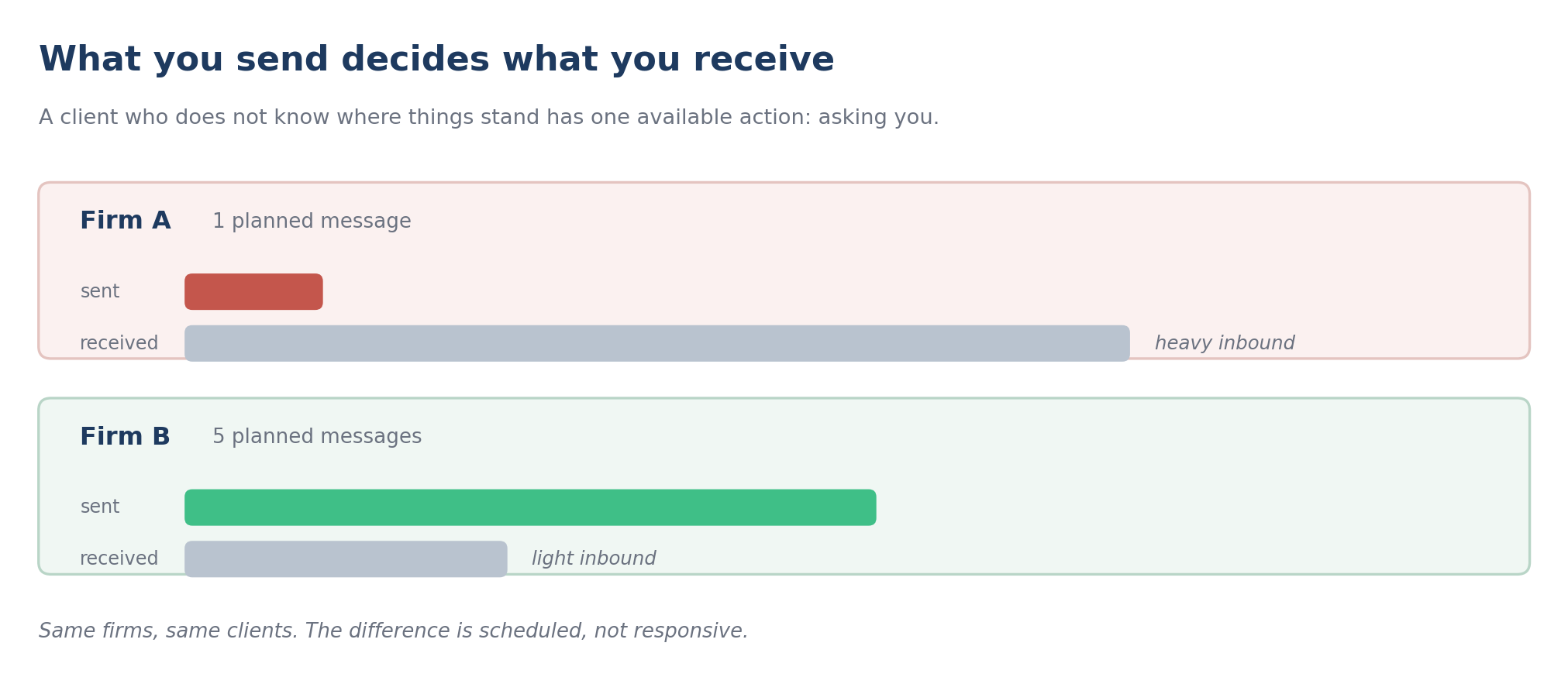
Inbound client email runs inverse to the volume you send on a schedule. Firms that send four planned updates across the season take fewer calls than firms that send one and then answer questions as they come.
What you send decides what you receive
A client who does not know where things stand has one available action: asking you.
Firm A — 1 planned message
- Sent: short
- Received: heavy inbound
Firm B — 5 planned messages
- Sent: long
- Received: light inbound
Same firms, same clients. The difference is scheduled, not responsive.
The reason is not goodwill. A client who does not know where things stand has one available action, which is to ask you. Remove the uncertainty and you remove the action.
This also decides how the client remembers the engagement. A firm that went quiet for six weeks and then delivered a return on time is remembered as slow. A firm that said three sensible things in that window and delivered on the same day is remembered as organized. Same work, same date.
The six messages a filing season needs
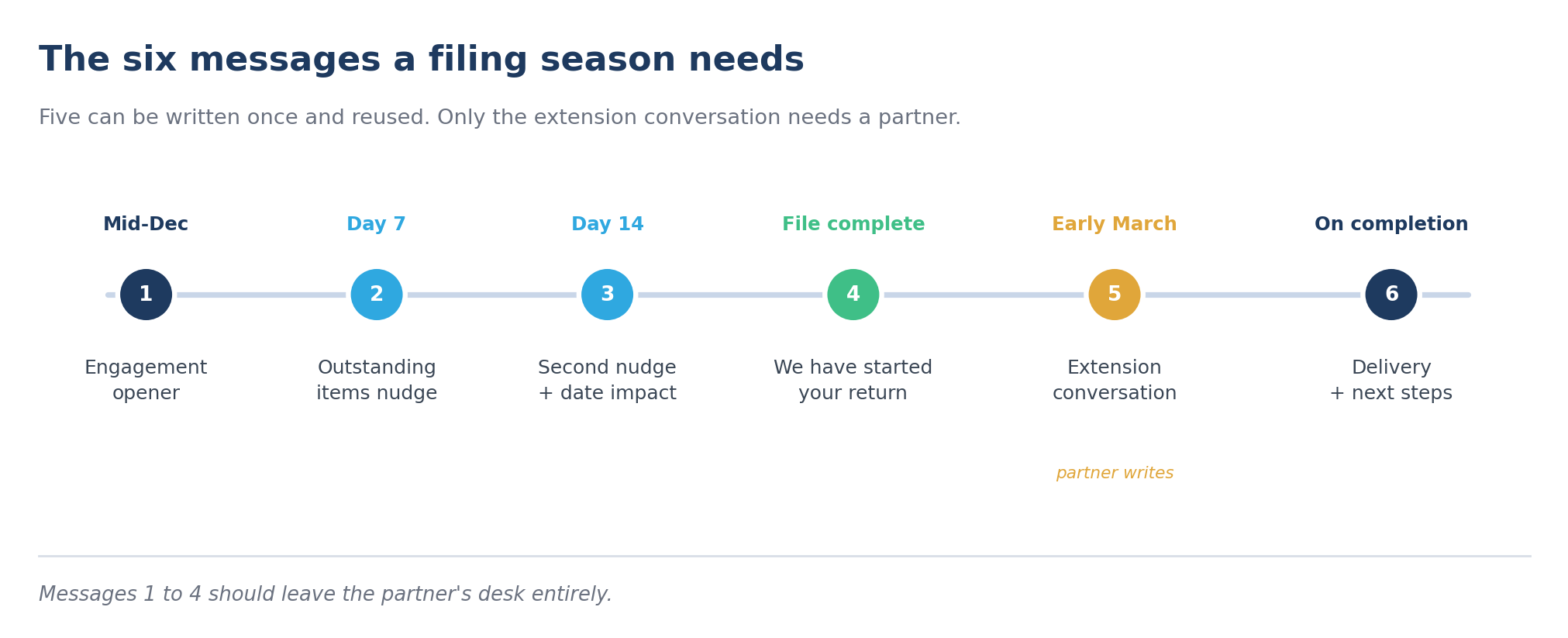
Most firms need six, and only two of them are difficult to write.
| # | Message | When |
|---|---|---|
| 1 | Engagement opener with the document request | Mid-December |
| 2 | Outstanding items nudge | 7 days after opener |
| 3 | Second nudge, with the effect on the filing date | 14 days after opener |
| 4 | We have started your return | When the file becomes complete |
| 5 | Extension conversation, where needed | Early March, not late March |
| 6 | Delivery, with what happens next | On completion |
The six messages a filing season needs
Five can be written once and reused. Only the extension conversation needs a partner.
-
1 · Mid-Dec
Engagement opener
-
2 · Day 7
Outstanding items nudge
-
3 · Day 14
Second nudge + date impact
-
4 · File complete
We have started your return
-
5 · Early March
Extension conversation — partner writes
-
6 · On completion
Delivery + next steps
Messages 1 to 4 should leave the partner's desk entirely.
Five of the six can be written once and reused with merge fields. The extension conversation is the one that needs a partner to write it, and it is the one most firms improvise under pressure.
Write them in November, not in March
March writing is bad writing. It is defensive, it is long, and it invites a reply that costs another twenty minutes.
Sit down in November with last season's sent folder and draft all six. Then hand them to the person who will actually send them, and confirm they can send messages 2 and 3 without asking a partner first. A reminder that needs partner approval does not go out on day seven.
Two rules that make the drafting quicker:
- Every message states what the client should do, or says in as many words that nothing is needed. "Just keeping you posted" leaves a client wondering whether it does.
- No message repeats a list the client has already partly satisfied. Send what is outstanding, not the original request again.
The two messages firms get wrong
The status update that says nothing
"Your return is in progress" is not an update. The client already assumed that, and it prompts the exact question it was meant to prevent.
An update needs one of three things: a change in what you need from them, a change in the expected date, or confirmation that a specific step is done. "We have everything we need and your return is with the preparer. You do not need to do anything else. We will send it for review by the 14th." That message ends a conversation.
Anything softer starts one.
The extension conversation
Most firms have this discussion too late, which converts a routine filing decision into an awkward one.
Two things make it easier. Have it in early March rather than the first week of April, when it is still a choice rather than an announcement. And separate the two facts a client actually cares about: whether they still need to pay by the deadline, and when the return will be filed. Clients hear "extension" and assume both have moved.
Write this one as a template with the reasoning left blank, so the partner fills in the specific cause and nothing else.
One channel, stated twice
Communication and intake share a channel problem. If clients can reply to a status email with a document attached, your document request list stops being the record of what arrived.
State the channel in the engagement letter and again in message 1. When a client sends a document by email anyway, reply with one line pointing them back and nothing else. Explaining the reason invites a debate about it.
Firms that hold this for one season stop having the problem in the next.
Who sends what
The most common failure is not the content. It is that every message belongs to whoever owns the client relationship, which in March means the partner, which means it does not go out.
Who sends what
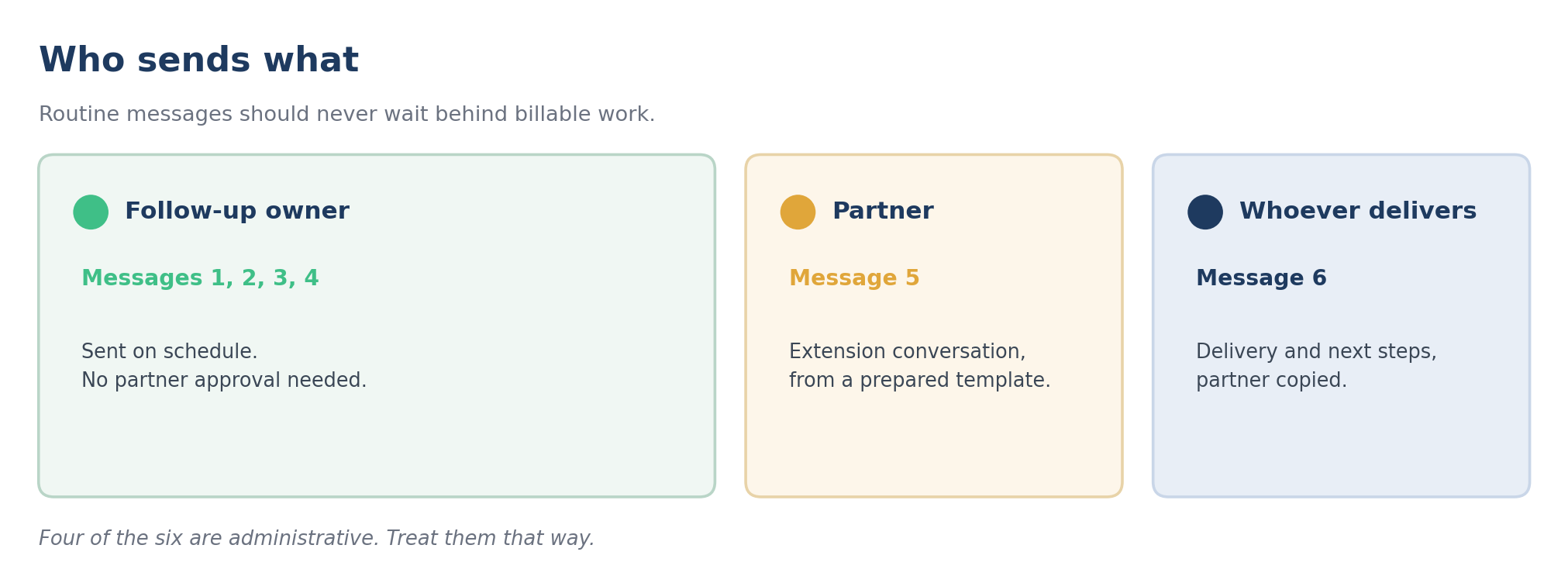
Routine messages should never wait behind billable work.
-
Follow-up owner
Messages 1, 2, 3, 4. Sent on schedule. No partner approval needed.
-
Partner
Message 5. Extension conversation, from a prepared template.
-
Whoever delivers
Message 6. Delivery and next steps, partner copied.
Four of the six are administrative. Treat them that way.
A split that works in most firms:
- Messages 1, 2, 3, 4: the follow-up owner, sent on schedule without approval
- Message 5: the partner, using the prepared template
- Message 6: whoever delivers the return, with the partner copied
The point is that the routine messages leave the partner's desk entirely. Four of the six are administrative and should never wait behind billable work. This is the same constraint that governs CPA firm capacity: partner time is the scarcest resource in the building and it gets spent on the wrong things by default.
What to measure
Three numbers, none of which need software:
- Inbound status questions, counted weekly. If this is not falling by season three, the planned messages are not landing.
- Days between a file becoming complete and message 4 going out. This should be under two.
- Extension conversations happening after 25 March. These should trend toward zero.
The first is the one that tells you whether any of it is working. It is also the one nobody tracks, because each individual question feels too small to log.
Frequently asked questions
How often should a CPA firm contact clients during tax season?
Four to six planned messages across the season is enough for most individual engagements: the opener with the document request, one or two nudges on outstanding items, a note when work begins, and delivery. More than that starts to read as noise. Fewer than that and clients fill the silence by contacting you, which costs more time than the messages would have.
What should a CPA tell a client when filing an extension?
Separate the two things clients conflate. Say whether payment is still due on the original deadline, and give a specific date for when the return will be filed. Add one sentence on what caused the extension and what you need from them, if anything. Having the conversation in early March rather than April keeps it a decision rather than an announcement.
When should a CPA firm tell clients about a fee increase?
Before the engagement letter goes out, not in the invoice. A fee change delivered in December alongside the engagement terms is a normal business message. The same change discovered on an April invoice reads as a surprise, and it is the most common cause of a client leaving after an otherwise fine season.
Should tax season updates go by email or client portal?
Whichever one you will hold to for the whole season. The channel matters less than the consistency, because the cost comes from documents and questions arriving in several places at once. Say which channel in the engagement letter, repeat it in the first message, and redirect when a client uses another.
Where AmitaSoft fits
The six messages are a writing job, and no software will do that part for you. What software changes is whether message 4 goes out on time, because that depends on somebody noticing that a file became complete.
TaxFlo is our tax workflow software for CPA firms. It runs the engagement rather than the folder. Each engagement shows what has arrived and what is still outstanding, so the moment a file becomes complete is visible rather than discovered. Clients move through a guided intake that adapts to their situation instead of a standard checklist, and documents already held from last year get offered for reuse rather than requested again, which is what keeps message 2 short.
The preparer stays in control. Every suggestion goes to a preparer to approve, change, or override, and overrides get logged, so the way your firm works shapes what the system suggests next season. TaxFlo does not prepare or file the return, and it does not write to your clients. Your firm does both, the way it does today.
Firms access TaxFlo through the SafeVault provider portal. You apply, get reviewed, and then manage engagements from your own dashboard.
If you are planning next season's communication now, schedule a demo and we can look at where your clients lose visibility today.