
Most follow-up emails in filing season trace back to the request that started the engagement, not to the client who ignored it. Ask for "business expenses" and you get a shoebox. Ask for "2025 mileage log and Q4 credit card statements" and you get those two files. The distance between those outcomes is the number of times your staff has to write again.
Firms that want to know how to reduce tax season follow ups usually look for a tool first. The volume drops further, and sooner, when you change how the request is written and where the documents land. Follow-ups are the largest uncounted cost in a small firm's busy season. They stay off the capacity plan because no one bills them and no one counts them, which is why firm capacity during filing season gets planned around returns and then disappears into chasing.
Where the follow-ups start
Sit with a preparer for an hour in early March and the same four causes come up.
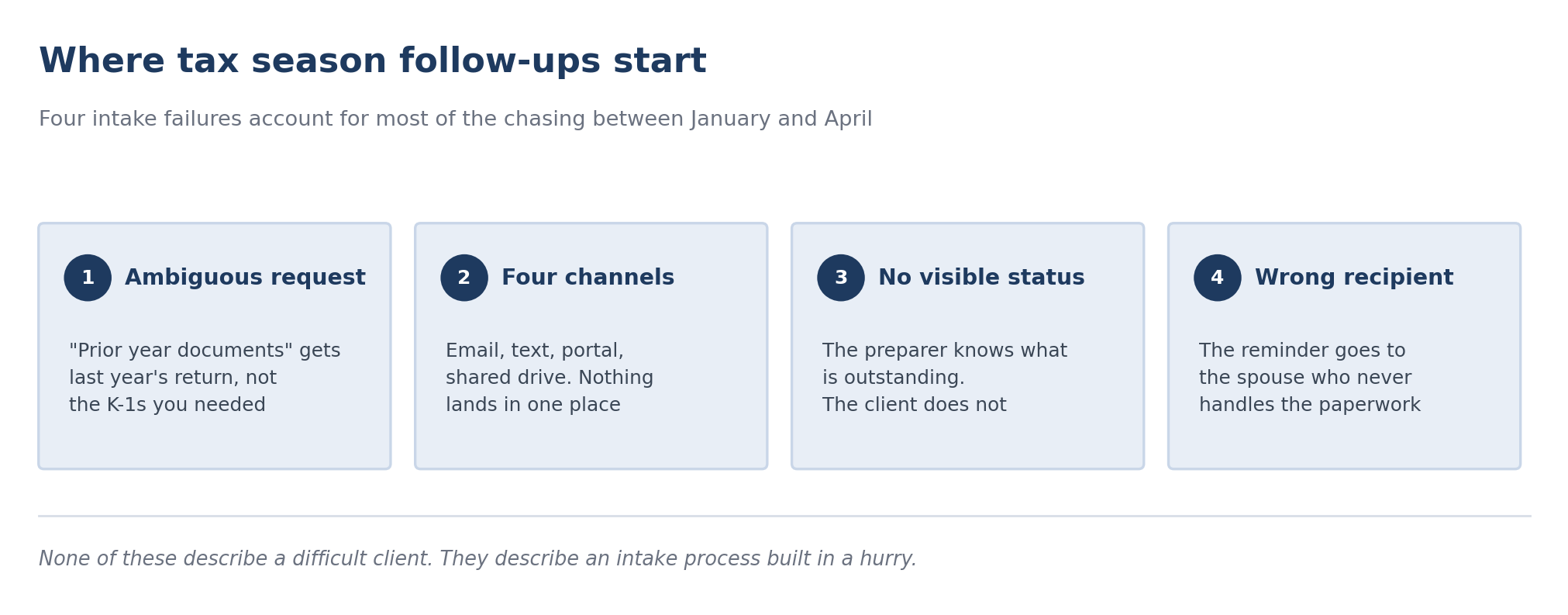
Where tax season follow-ups start
Four intake failures account for most of the chasing between January and April.
-
Ambiguous request
“Prior year documents” gets last year’s return, not the K-1s you needed.
-
Four channels
Email, text, portal, shared drive. Nothing lands in one place.
-
No visible status
The preparer knows what is outstanding. The client does not.
-
Wrong recipient
The reminder goes to the spouse who never handles the paperwork.
None of these describe a difficult client. They describe an intake process built in a hurry.
- The request was ambiguous. The client read "prior year documents" and sent last year's return instead of the K-1s you needed. Both of you were right.
- The documents arrived across four channels. Two by email, one by text to a staff member's phone, one dropped into a portal nobody checked.
- Nobody could see what was still outstanding. Your preparer knew. The client did not, and asking meant another email.
- The follow-up went to the wrong person. You emailed the spouse who does not handle the paperwork.
None of these describe a difficult client. They describe an intake process built in a January when the firm was already behind.
Count your follow-ups before you change anything
Firms fix whatever annoyed them most last April. That is seldom the thing costing the most hours.
Run one filing season with a log. It needs four columns and takes a preparer under a minute per entry:
- Client name
- Document being chased
- Which attempt this is (first, second, third)
- Why the first request did not produce it
By April you will have a ranked list of the documents your firm chases most. In most small firms, five or six document types account for the bulk of the volume. K-1s, brokerage statements, and anything belonging to a rental property show up near the top.
Fix those five. Ignore the long tail for now.
Write requests a client can act on without thinking
A document request list works when the client can read a line and know whether they have that item in front of them or not.
Three changes to how you write the list
One document per line
"Bank and brokerage statements for all accounts" is four documents for a client with four accounts, and they will send two. Split it. A list of twelve specific lines gets returned more completely than a list of four broad ones, even though it looks longer.
Name the year and the form number
"2025 Form 1098 from your mortgage servicer" leaves no room for a client to send the 2024 one. Form numbers feel technical, but clients recognize them from the document itself, which is exactly why they work.
Say where the client will find it
Most people have never looked for a 1099-INT and do not know their bank posts it under Tax Documents in online banking. One sentence saves a phone call.
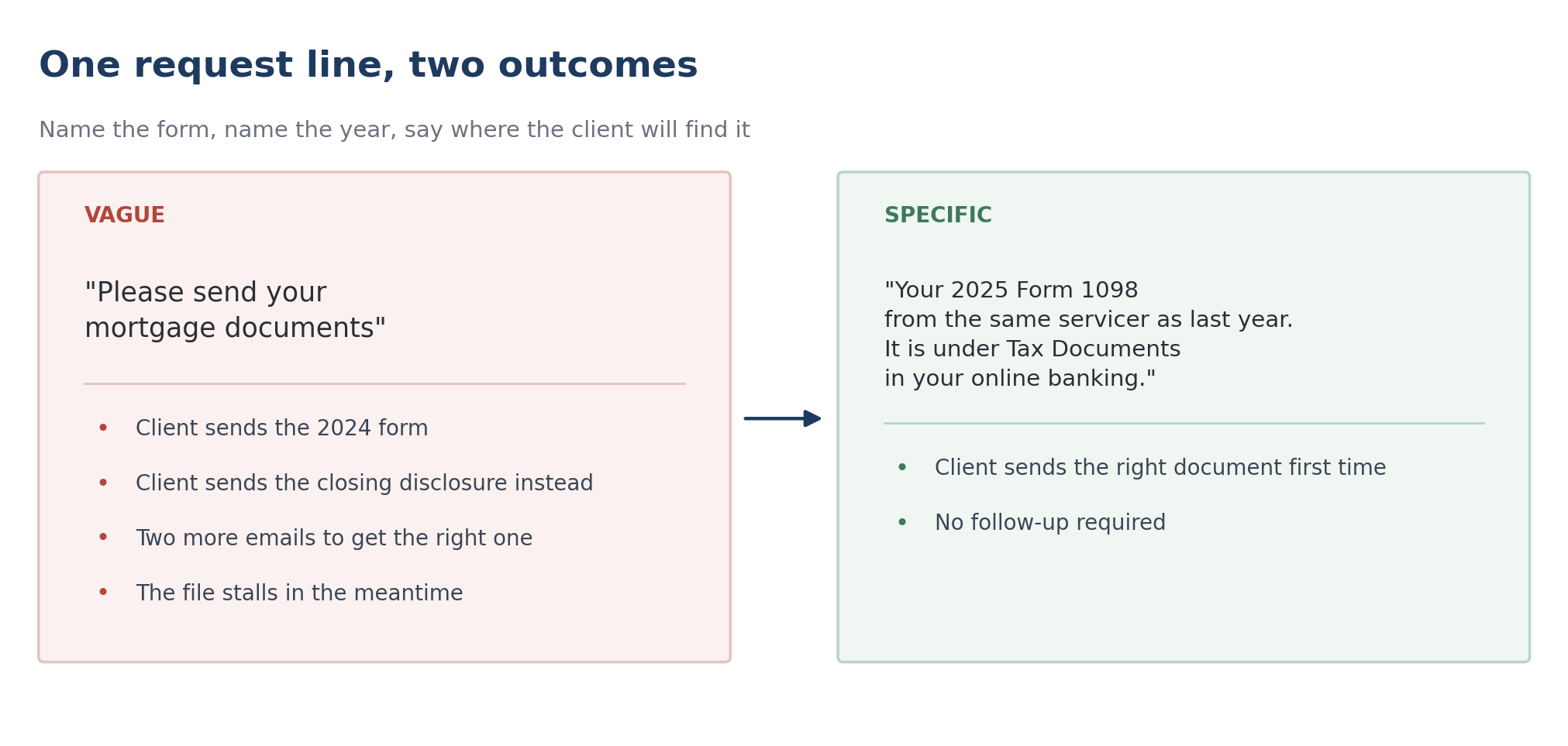
One request line, two outcomes
Name the form, name the year, say where the client will find it
Vague
“Please send your mortgage documents”
- Client sends the 2024 form
- Client sends the closing disclosure instead
- Two more emails to get the right one
- The file stalls in the meantime
Specific
“Your 2025 Form 1098 from the same servicer as last year. It is under Tax Documents in your online banking.”
- Client sends the right document first time
- No follow-up required
A well-built tax organizer does most of this work for you, provided you edit it per client rather than sending the same template to a retiree and a partnership.
Stop asking for what you already hold
A returning client who sent you their mortgage interest statement last February will notice when you ask for the same document from the same lender this February. Some of them say so. Most send it again and quietly think less of the firm.
Before the request goes out, check the prior-year file. Anything that does not change year to year, entity documents, property records, dependent information, comes off the list. Anything that changes but comes from the same source gets a narrower request: not "mortgage documents" but "your 2025 1098 from the same servicer as last year."
Building the request from the prior-year return rather than from a blank template also catches the opposite problem, the schedule that appeared last year and that nobody remembered to ask about this year.
Give clients one place to send things
Every additional channel multiplies your follow-ups, because a document that arrives by text does not show up in the place your preparer is tracking. The staff member who received it has to remember to log it, and in March they will not.
Pick one channel. Say so in the engagement letter, repeat it in the first request, and hold the line when a client emails an attachment anyway. Send one sentence pointing them back to the portal. Two rounds of that trains most clients for the rest of the season.
The firms that struggle here are the ones that accept documents anywhere out of politeness, then absorb the cost in reconciliation.
Let the client see what is outstanding
Half the follow-up emails a firm sends exist to answer a question the client could have answered alone: what do you still need from me.
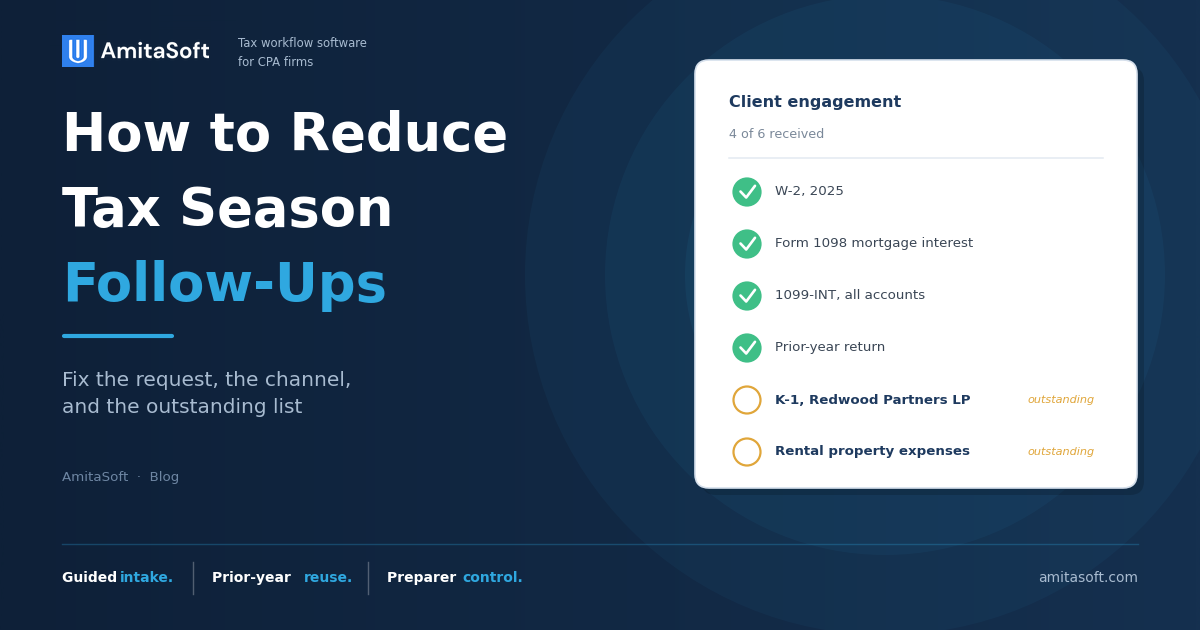
When a client can open a link and see six items with four ticked off, they act on the remaining two without being asked. When they cannot see it, they wait for you to tell them, and you become the reminder system for your own request.
Any tool that shows a live outstanding list will cut your second and third follow-ups. A shared spreadsheet with a status column works if that is what you have this year.
Set the cadence before January
Decide the follow-up schedule in November and write it down, because nobody makes a good decision about cadence in the third week of March.
A schedule most firms can hold
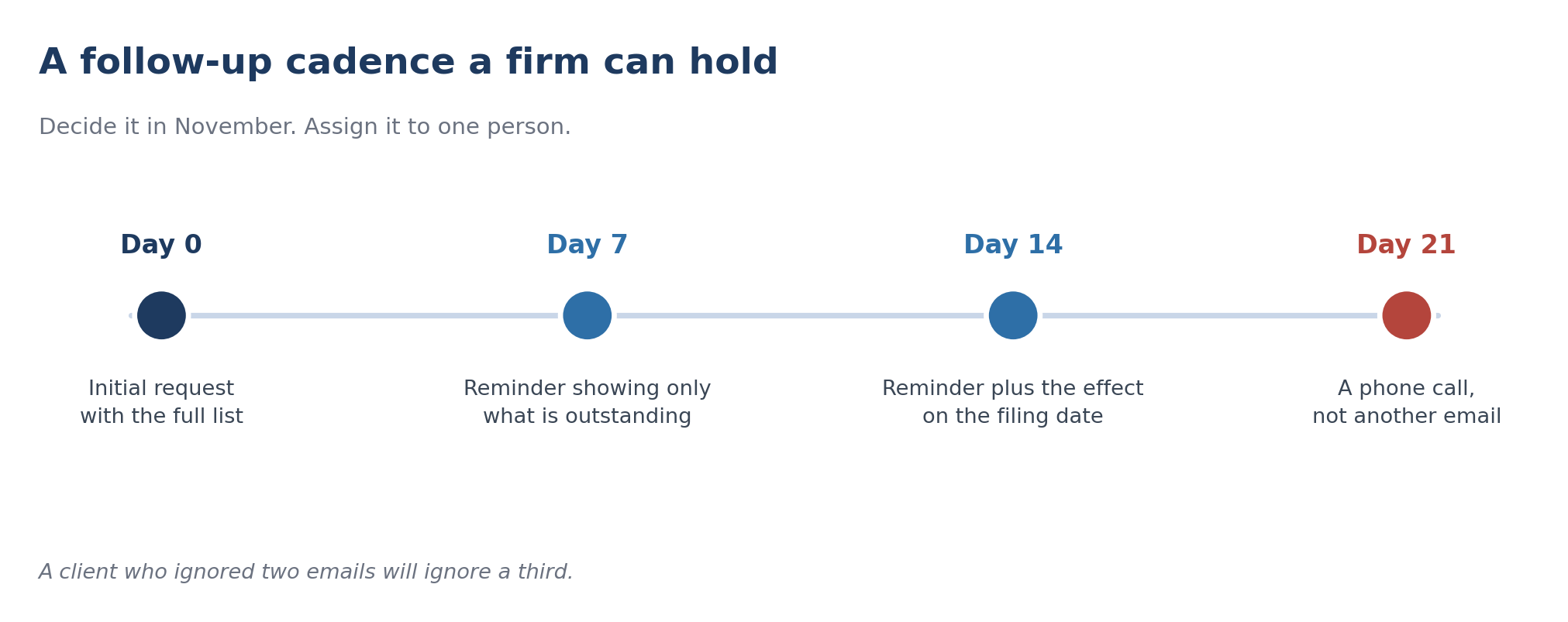
A follow-up cadence a firm can hold
Decide it in November. Assign it to one person.
-
Day 0
Initial request with the full list
-
Day 7
Reminder showing only what is outstanding
-
Day 14
Reminder plus the effect on the filing date
-
Day 21
A phone call, not another email
A client who ignored two emails will ignore a third.
Days 0 to 14: written reminders
- Day 0: initial request with the full list
- Day 7: reminder showing only what is outstanding, not the whole list again
- Day 14: reminder plus a note about what happens to the filing date
The day 7 reminder matters more than it looks. Resending the full list makes a client who has already sent four documents feel unseen, and they deprioritize you.
Day 21: pick up the phone
The third email is where firms lose people. A client who ignored two emails will ignore a third. Call them.
Assign the cadence to one person. A preparer chasing clients between returns will put the chase last.
If you change one thing this year
Rewrite the request list for the five documents you chased most last season. Name the form, name the year, and say where the client will find it.
That single change costs you an afternoon in December and removes more follow-ups than any software you buy in February.
The rest of it, one channel, a visible outstanding list, and a cadence somebody owns, is worth doing in the same off-season. None of it works during filing season, which is why November and December decide how April goes.
Frequently asked questions
What documents does my CPA need from me?
For most individual returns: last year's return, W-2s and 1099s for the year being filed, mortgage interest and property tax statements, brokerage and retirement account statements, records of estimated tax payments, and records for any deduction you plan to claim. Business owners add profit and loss statements, balance sheets, payroll records, and asset purchase records. Your CPA should send a list specific to your situation rather than a generic one, because a retiree and a partnership need different things. If you received a request list that feels generic, ask for one built from your prior-year return.
How many times should a CPA firm follow up before calling?
Two emails, then a call. A client who has ignored two written reminders will ignore a third. Firms that set this cadence in advance and assign it to one person spend less time chasing than firms that leave each preparer to decide.
When should a firm send the first document request?
Send the initial request in December or the first week of January, before the client's documents start arriving from banks and employers. A request that lands while the client is still collecting mail gets acted on. A request that lands in late February competes with everything else on their desk.
Does a tax organizer reduce follow-ups?
It does when someone edits it for the client. A generic organizer sent to every client produces the same ambiguity as a generic email, and clients skip whatever looks irrelevant to them. An organizer built from the prior-year return, with the irrelevant sections stripped out, gets returned more often and with fewer gaps.
Where AmitaSoft fits
A spreadsheet and some discipline will carry a firm a long way on all of this. It starts to break around the point where forty engagements are running at once and the only record of where each one stands is in one person's head.
TaxFlo is our tax workflow software for CPA firms. It runs the engagement rather than the folder. Clients work through a guided intake that adapts to their situation instead of a standard checklist, so a straightforward return does not collect the questions a complicated one needs. Documents the client already holds from last year get offered for reuse rather than requested again. Each engagement shows what has arrived and what is still outstanding, so answering "can we start this one?" does not mean opening the file.
The preparer stays in control. Every suggestion goes to a preparer to approve, change, or override, and overrides get logged, so the way your firm works shapes what the system suggests the following season. TaxFlo does not prepare or file the return. Your firm does that the way it does today, and the finished return goes back into the engagement.
Firms access TaxFlo through the SafeVault provider portal. You apply, get reviewed, and then manage client engagements from your own dashboard.
If tax season follow-ups are eating your capacity, schedule a demo and we can look at where your requests are breaking down before the season starts.