
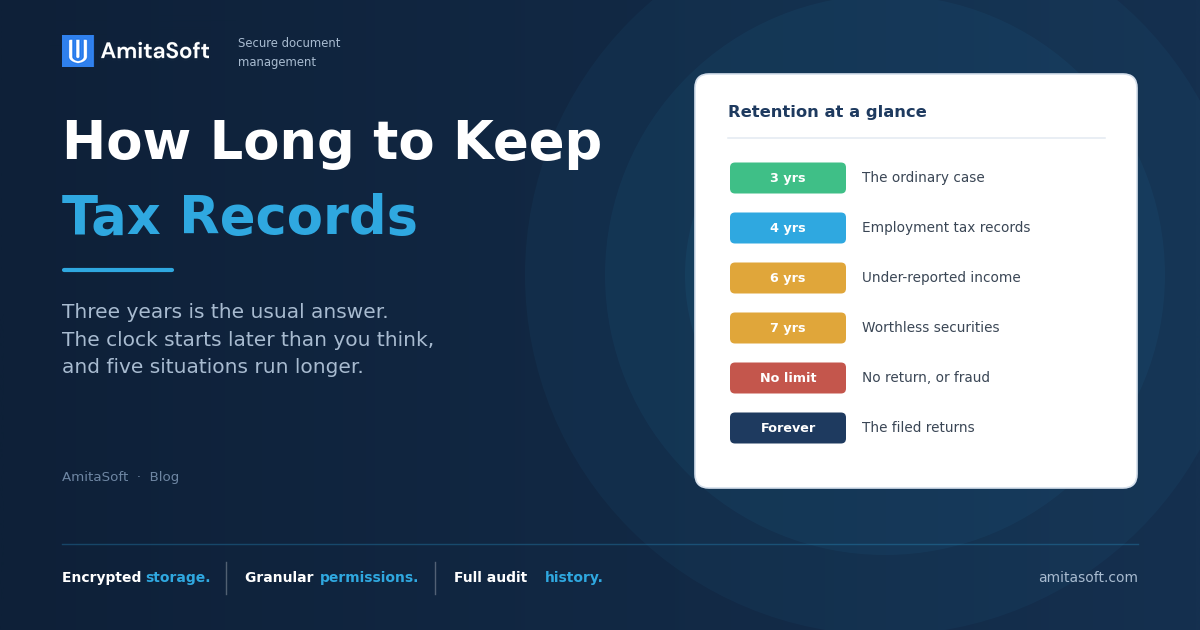
Three years covers most people. That is the period the IRS generally has to assess additional tax on a return you filed, so it is how long you need the paperwork that backs up the income, deductions, and credits on it.
Two things make the real answer harder. The three years runs from the date you filed, not from the end of the tax year, which pushes the finish line later than most people assume. And there are five situations where the period is longer, one where it never runs out, and a category of documents you may need to keep for thirty years or more.
This covers all of them.
This is general information about record retention, not tax advice. Your situation may differ, and state rules are separate from federal ones. Check with your CPA before disposing of anything you are unsure about.
The clock starts when you file
This is where the arithmetic goes wrong.
Say you filed your 2025 return on 10 April 2026. The three-year period runs from that filing date, so it ends in April 2029, not in December 2028. If you filed early, the IRS treats the return as filed on the due date, so filing in February does not start your clock any sooner.
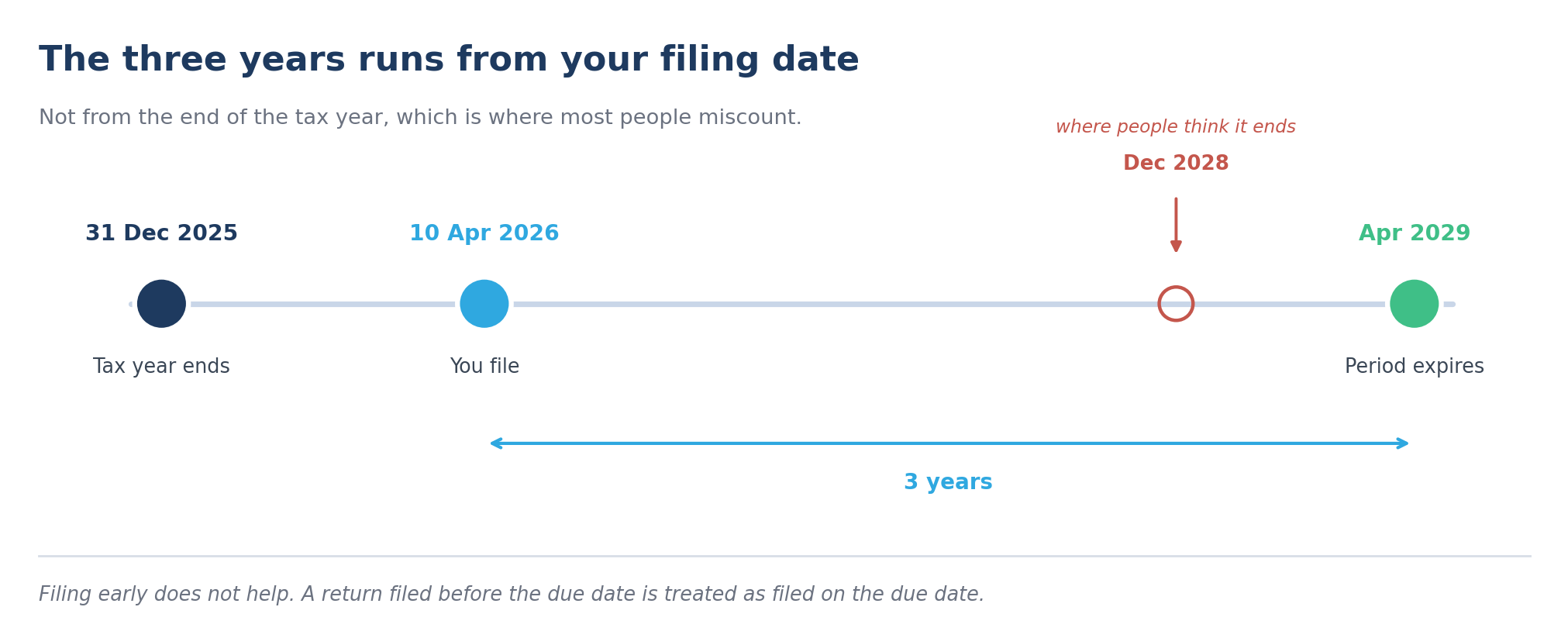
The three years runs from your filing date
Not from the end of the tax year, which is where most people miscount.
-
31 Dec 2025
Tax year ends
-
10 Apr 2026
You file
-
Dec 2028
Where people think it ends
-
Apr 2029
Period expires — 3 years from filing
Filing early does not help. A return filed before the due date is treated as filed on the due date.
If you filed late, or on extension in October, the clock starts later still. An October filing pushes the end of the period to October three years on.
The practical effect is that most people can safely dispose of a year's supporting documents about three years and four months after the end of the tax year, not three years. When in doubt, count from the date on your filing confirmation.
Every IRS retention period, in one table
The IRS sets the period by situation rather than by document, which is why the usual advice feels vague. These are the periods it publishes:
| Situation | Keep records for |
|---|---|
| The ordinary case, none of the below applies | 3 years |
| You file a claim for credit or refund after filing the return | 3 years from filing, or 2 years from paying the tax, whichever is later |
| You claim a loss from worthless securities or a bad debt deduction | 7 years |
| You under-report income by more than 25% of the gross income shown on the return | 6 years |
| You do not file a return at all | No limit |
| You file a fraudulent return | No limit |
| Employment tax records, if you have household or business employees | At least 4 years after the tax is due or paid, whichever is later |
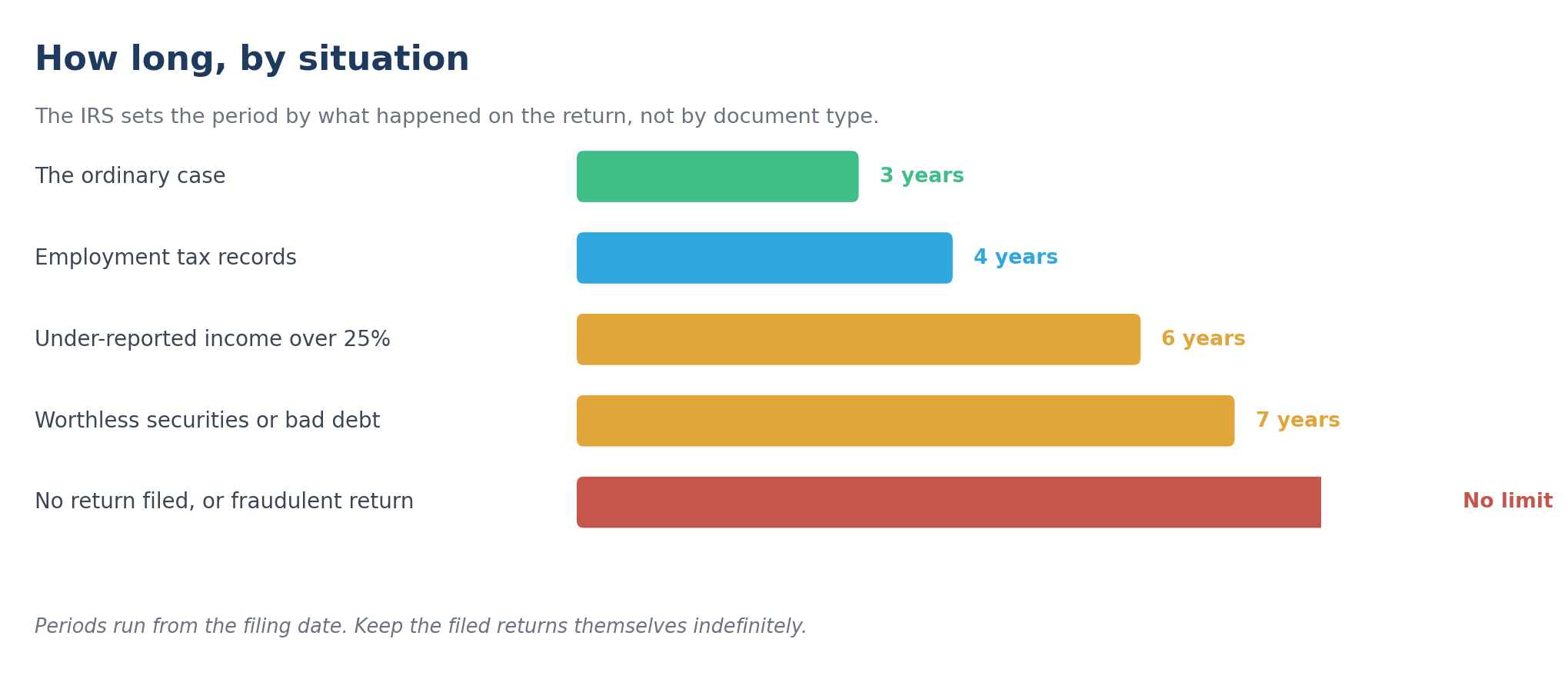
How long, by situation
The IRS sets the period by what happened on the return, not by document type.
-
The ordinary case
3 years
-
Employment tax records
4 years
-
Under-reported income over 25%
6 years
-
Worthless securities or bad debt
7 years
-
No return filed, or fraudulent return
No limit
Periods run from the filing date. Keep the filed returns themselves indefinitely.
The six-year rule also applies to unreported income from foreign financial assets above a set threshold. If you hold assets abroad, treat six years as your baseline rather than three.
Full detail is on the IRS pages for Topic no. 305, Recordkeeping and How long should I keep records?.
Keep the returns themselves indefinitely
The periods above apply to the supporting documents. The filed return is a different matter, and the IRS itself recommends keeping copies.
Returns are small, and you will use them. They are needed to prepare the following year, to file an amended return, to prove income for a mortgage or a visa application, to establish contribution history, and to answer questions about a year nobody remembers. A folder of thirty PDFs takes no space and saves an afternoon more than once.
The rule most people can live with: dispose of the receipts, keep the returns.
The records that outlive the three-year rule
This is the part the standard three-year answer hides, and it is where real money gets lost.
Anything with a cost basis
You keep records relating to property until the period of limitations expires for the year you dispose of it in a taxable transaction. Not the year you bought it.
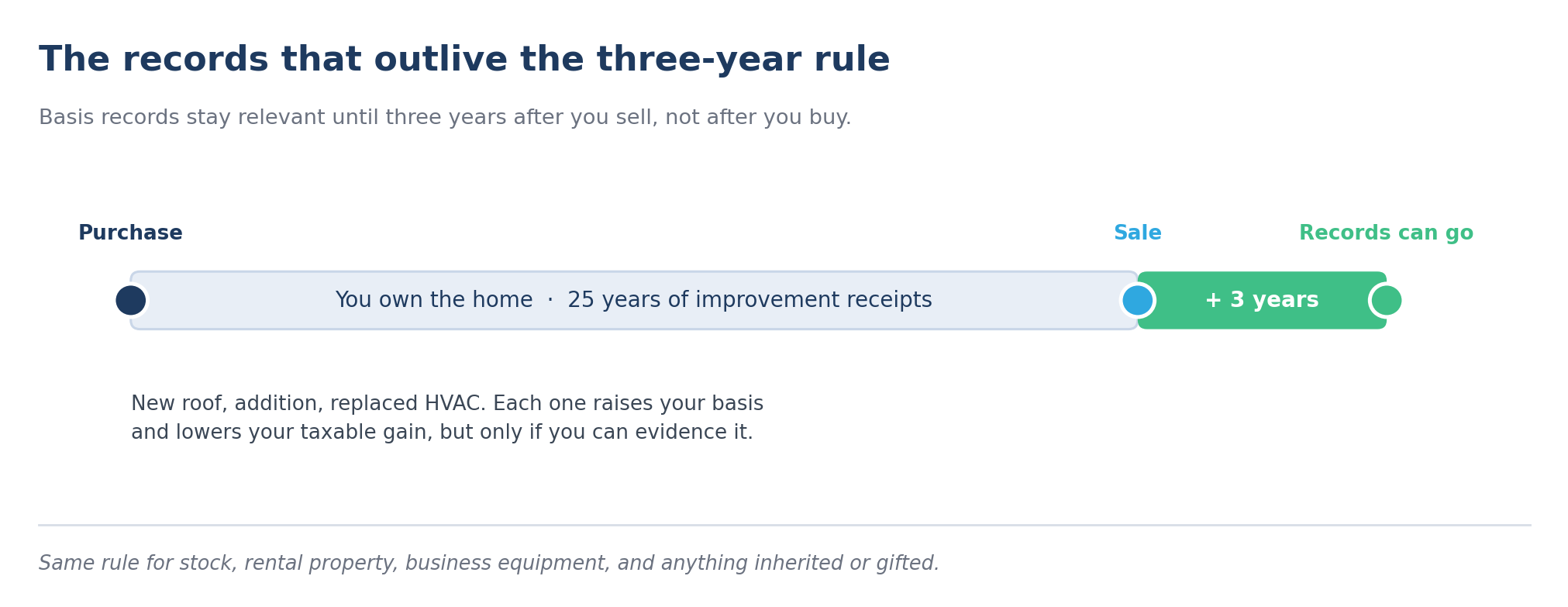
The records that outlive the three-year rule
Basis records stay relevant until three years after you sell, not after you buy.
-
Purchase
You own the home · 25 years of improvement receipts
-
Sale
+ 3 years
-
Records can go
New roof, addition, replaced HVAC. Each one raises your basis, but only if you can evidence it.
Same rule for stock, rental property, business equipment, and anything inherited or gifted.
For a house owned for twenty-five years, that means the purchase documents, closing statement, and every improvement receipt stay relevant for twenty-five years plus the limitation period after you sell. Thirty years is not unusual.
The reason is arithmetic. Your gain on sale is the sale price minus your basis, and your basis includes what you paid plus qualifying improvements. A new roof, an addition, a replaced HVAC system: each one raises your basis and lowers your taxable gain, but only if you can evidence it. Homeowners pay tax on gains they did not have because a decade of improvement receipts went in the bin.
The same logic covers stock purchases, rental property, business equipment, and anything inherited or gifted where you need to establish basis.
Carryforwards
Anything carried from one year into a future one keeps its supporting documents alive for as long as the carryforward does. Capital losses that offset gains years later, net operating losses, unused credits, and passive activity losses all fall here.
The test is simple. If a number on this year's return came from a prior year, keep the prior year's records until the carryforward is fully used, then apply the normal period from that year.
Retirement account basis
Non-deductible IRA contributions create basis you will need decades later to avoid paying tax twice on the same money. The forms recording those contributions belong with your permanent records, not your three-year pile. The same applies to records establishing the start of a Roth account.
By document type, in practice
Situations are how the IRS thinks. Documents are what is actually in your drawer. Translating between the two:
| Document | Keep for |
|---|---|
| Filed tax returns | Indefinitely |
| W-2s, 1099s, and other income records | 3 years after filing |
| Receipts and statements supporting deductions | 3 years after filing |
| Bank and credit card statements used for tax | 3 years after filing |
| Investment purchase confirmations | Until 3 years after the year you sell |
| Home purchase, closing, and improvement records | Until 3 years after the year you sell |
| Rental property records | Until 3 years after the year you dispose of it |
| Records of non-deductible IRA contributions | Indefinitely |
| Records supporting a carryforward | Until the carryforward is used, then 3 years |
| Employment tax records | At least 4 years |
| Records for a year you did not file | Indefinitely |
Where a document does two jobs, the longer period wins. A brokerage statement that supports both a dividend on this year's return and the basis of a stock you still hold is a basis record until you sell.
State rules are separate
Federal retention periods do not govern your state return. State agencies set their own limitation periods, and several run longer than the federal three years.
You will also struggle to reconstruct a state position from a federal record after the fact. The practical approach is to find your state's period once, take the longer of the two, and apply that to everything for that year. Most state revenue departments publish it.
When you can dispose of records, and how
Once a year's period has expired and nothing on the list above extends it, the documents can go.
Two things worth getting right:
- Shred anything with an account number, a Social Security number, or a signature. Tax paperwork is the densest concentration of identity documents most households produce, and a recycling bin is not disposal.
- Check for basis records before you shred a year. This is the single most common expensive mistake. A 2004 folder may contain the closing statement for a house you still own.
If your records are digital, "disposing" means deleting them from every place they exist, including the backup and the email thread you sent them to your accountant in. A file you forgot about is still a file somebody can obtain.
Frequently asked questions
How long should I keep tax returns?
Keep copies of the filed returns indefinitely. The IRS recommends it, and they take almost no space. The three-year rule applies to the supporting documents behind the return, not to the return itself. You will need old returns to prepare future ones, to file an amended return, and to prove income for lenders and other institutions.
Can I throw away tax records after 3 years?
Usually, but check three things first. Confirm the three years is counted from your filing date rather than the tax year end. Confirm none of the longer periods apply, particularly if you claimed a bad debt or worthless securities loss. And confirm the folder holds no records establishing the cost basis of something you still own, which is the most common reason a document should stay past three years.
How long do I need to keep records for a house I sold?
Until the limitation period expires for the year of sale, which is generally three years after you filed the return reporting it. That means the purchase documents and improvement receipts from the entire ownership period need to survive until then. For a long-held home this can be several decades of paperwork, and it is what allows you to prove your basis and reduce the taxable gain.
Do digital copies count for the IRS?
The IRS accepts electronic records provided they are legible, complete, and retrievable. A clear scan of a receipt is acceptable. What matters is whether you can produce the document if asked, which means a searchable and backed-up system rather than a folder of photographs on an old phone.
How long should I keep tax records after someone dies?
Longer than usual, and this is a case to take to a professional. The estate has its own filing obligations, basis is generally re-established at death, and beneficiaries may need the decedent's records to support their own returns for years afterwards. Keep everything until the estate is fully settled and a CPA confirms what can be released.
A simpler way to hold all of this
Retention rules are less complicated than they are long-running. The difficulty is that the answer for a given document depends on when you filed, what you claimed, and whether you still own something you bought twenty years ago. That is a lot to hold in a filing cabinet and a memory.
SafeVault helps protect sensitive personal, financial, and family documents with encrypted document handling, secure access controls, and intelligent organization. Documents are classified and validated as they arrive, so a closing statement is filed as a closing statement rather than as a PDF with a number for a name.
Two things matter for retention specifically. You can set policies for renewals, expirations, and reminders, so a document with a known review date surfaces on its own instead of being rediscovered during a clear-out. And sharing runs on granular permissions with full audit history, which matters when the person who needs a document is your accountant, your lender, or a family member acting on your behalf.
It is not a filing service and it does not decide what to keep. That judgement stays with you and your CPA.
If you want the documents you will need in twenty years to still be findable in twenty years, schedule a demo.